Short answer
There’s no official list of “best” settings for the Fanatec Podium Pedals. What does exist is Fanatec’s own explanation of everything you can adjust, from the elastomers in the brake to the pedal curves in the Fanatec App. That’s enough to build a solid baseline yourself. And honestly, that beats copying someone else’s numbers, because your leg, your rig and your cars aren’t theirs.
Quick status check. The Podium Pedals Formula (the two-pedal set) have been on sale since late June 2026 for €699.95, but they keep selling out in waves (SimRacingCockpit.gg). The three-pedal set with a clutch was delayed by a quality issue with the clutch pedal.
What are the Fanatec Podium Pedals exactly?
“Podium” is Fanatec’s top tier, known from the Podium DD wheelbases and the expensive steering wheels (Fanatec Podium DD). The Podium Pedals are Fanatec’s new flagship pedals and sit above the ClubSport Pedals V3.
The brake is the heart of it. Fanatec uses a load cell rated for more than 200 kg, calibrated for 150 kg of force at the pedal plate (Fanatec). For comparison, the ClubSport Pedals V3 top out at 90 kg. The throttle uses a Hall sensor. On PC you connect the set standalone over USB-C, and over RJ12 to a Fanatec wheelbase for PlayStation and Xbox.
Why there’s no universal “best” setting
Brake pedal feel is personal. It depends on:
- Driving style: trail braking wants a different curve than hard, straight-line braking.
- Car type: a GT3 car with ABS needs a different response than a formula car without it.
- Rig rigidity: a pedal set up for 150 kg is wasted on a light cockpit that flexes.
- Your own leg: how hard you can comfortably push decides where you want 100% brake.
Settings are always a starting point, never a recipe.
What can you adjust on the Podium Pedals?
The brake: Compression Control System
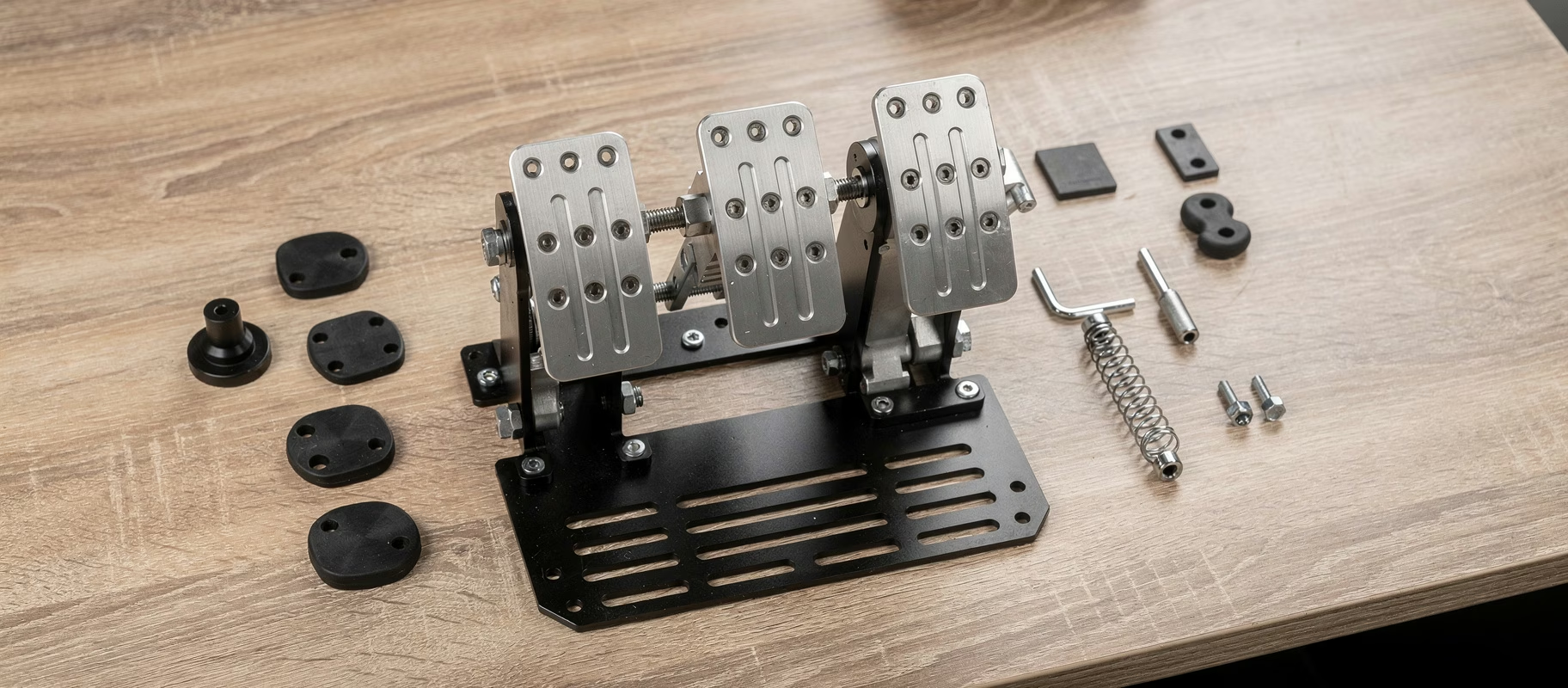
Fanatec calls the brake mechanism the Compression Control System. It’s a stack of elastomers surrounded by threaded metal cups that act as mechanical limiters. Screw a cup further closed and that elastomer gets less room to compress. Fully open gives you the longest travel, which Fanatec says suits simulating a road car. Fully closed feels like pushing against a wall, like some race car brakes (Fanatec).
The clever part: set the cups at staggered heights and each elastomer bottoms out at a different point in the stroke. The remaining elements carry the rest of the load, so resistance climbs in steps. That turns a linear pedal into a progressive one, purely mechanically. Want it softer? The box also includes springs (blue is soft, green is softest) that you can mix into the stack with the elastomers. All tool-free.
The throttle
Throttle travel and preload adjust independently, also without tools. According to the product page you get about 20 mm of travel adjustment (Fanatec).
Pedal plates and heel rest
The carbon pedal plates are height adjustable and the heel rest adjusts for distance. Sounds boring. But a pedal sitting in the wrong spot under your foot never feels right, no matter how nice your curve is.
Curves and dead zones in the Fanatec App
In the Fanatec App on PC you set a curve and dead zones per pedal. Pick a preset or build your own, then save it to the pedals’ own memory. Progressive gives you more control on small inputs, degressive makes the pedal respond earlier in its travel (Fanatec).
Tuning Menu or Fanatec App?
Both, and that’s exactly why people search online for “the best settings” and never find one answer. You create curves in the Fanatec App on PC. After that you can pick the presets and your own curves from your wheel’s Tuning Menu too. Because the curves live in the pedals themselves, they also work on console, in any game that supports analog pedal input (Fanatec). That’s a genuine step forward: console players don’t have to live with a factory curve.
Building your own setting
This order is the most reliable:
- Get the pedal plates and heel rest right first. Position before feel.
- Set up the brake mechanically. Start with all cups open and work toward the stiffness you want. Mostly GT3 and endurance? Try staggered cups for a progressive build-up. Formula? Screw toward the “wall”. Too heavy? Swap an elastomer for a blue or green spring.
- Set throttle travel and preload.
- Then try the presets in the Fanatec App. That’s Fanatec’s own advice too: presets first, custom curves later.
- Only then tweak a custom curve, for example if you struggle to modulate at light brake pressure.
- Test per car class: a curve that feels great in a GT3 car with ABS might feel nervous in a formula car without it.
- Change one thing at a time and drive a few laps before touching anything else. Otherwise you won’t know what made the difference.
Which Fanatec pedals can you buy right now?
Formula sold out again, or want three pedals? Here’s what else Fanatec sells:
| Pedal set | Best for | Key feature |
|---|---|---|
| Fanatec CSL Pedals | Beginners, budget-focused | Steel frame, later upgradeable with a load cell kit |
| Fanatec CSL Elite Pedals V2 | Intermediate racers | Load cell as standard, elastomers in three hardnesses |
| Fanatec ClubSport Pedals V3 | Serious/competitive racers | 90 kg load cell, vibration motors, all-metal construction |
The ClubSport Pedals V3 is the closest thing to the Podium Pedals in ambition: all-metal, a 90 kg load cell and vibration motors in throttle and brake. If you want to race seriously today, this is your move. The CSL Elite Pedals V2 is the middle ground, and the CSL Pedals stay the entry point.
One thing to keep in mind: on PlayStation and Xbox, all of these pedals, just like the Podium Pedals, only work through a Fanatec wheelbase.
Should you wait for the Podium Pedals?
That 150 kg at the pedal plate says it all: this is a pedal for people with a heavy, rigid rig who want to brake hard. Happy with your ClubSport V3 or CSL Elite V2? Then I don’t see much reason to wait, or to spend €700. If you specifically want three pedals with a clutch, you’ll need some patience either way. Fanatec pushed that set to Q3, so check the product page for the current status.
Already got the Formula on your rig? Then ignore other people’s numbers. Cups open, try the presets, one change at a time. That works better than any “best setting” you’ll find online.