The short answer
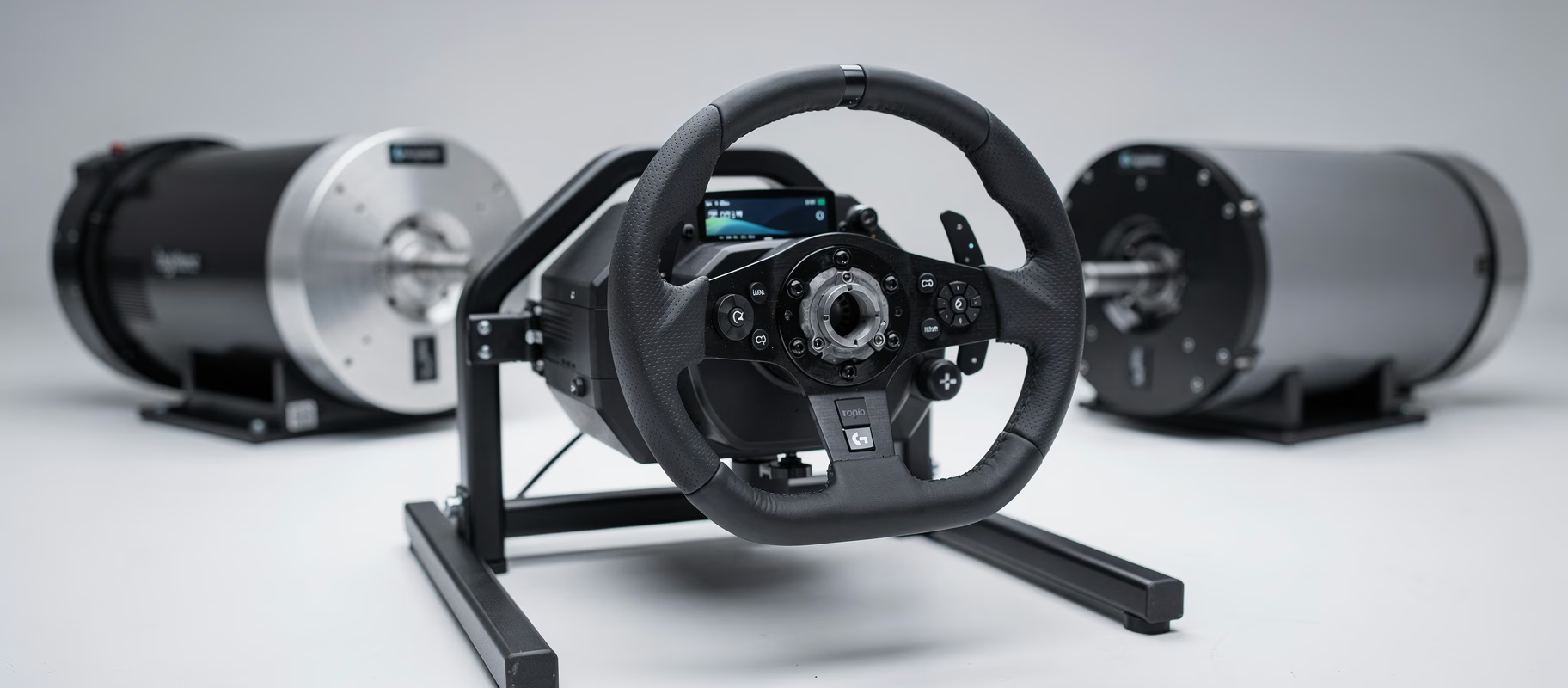
The Logitech G PRO Racing Wheel, built around the PRO DD11 base, was Logitech’s first direct drive wheel back in 2022 and delivers up to 11 Nm of torque (Logitech product page). That puts it squarely in the mid-range of the direct drive market: stronger than a Fanatec CSL DD without a boost kit, well below high-end bases like the Fanatec Podium DD2 or Simagic Alpha Ultimate. Racing on PlayStation, Xbox or PC and want one brand that just works? Then it’s a serious contender. Hunting for the cheapest way into direct drive? Look at the lighter Logitech G RS50 System instead.
What are you actually buying?
Like its competitors, Logitech splits the PRO series into a base and a wheel rim. The standalone PRO DD11 Wheel Base delivers 11 Nm and can be paired with different rims. The complete package, bundled with pedals, is listed as the Logitech G PRO Racestuur - PlayStation & PC + G Pro Racepedalen. This bundle includes:
- A direct drive base rated up to 11 Nm of force feedback
- A 30 cm (300 mm) wheel rim with a quick release
- An LED display for adjusting settings without opening software
- The PRO Racing Pedals, with a load-cell brake
- Support for PlayStation 5, PlayStation 4 and PC
At Dutch retailers this bundle sits around €1,300. Check the product page for the current price before you lock in a budget.
What about Xbox? It’s not in this bundle. Logitech sells the PRO Racing Wheel in three versions: PlayStation/PC, Xbox/PC and PC-only. Just like with the G923, you pick your console at checkout. The Xbox/PC version works with Xbox Series X|S and Xbox One, the PlayStation/PC version with PS5 and PS4. You can’t have both in one wheel. Buying piece by piece? The standalone DD11 base only comes in PC and PlayStation/PC versions. For Xbox you need the complete Xbox set of base and wheel.
What about your old Logitech gear?
Logitech sells a separate Racing Adapter that links the older G series and the PRO series (Logitech adapter page). It works both ways. Put a PRO or RS50 base on your desk and keep your G25, G27, G29, G920 or G923 pedals. Or keep your old G series wheel and add the PRO pedals with their load-cell brake. Handy, because if you own a Logitech G923 TRUEFORCE or Logitech G29, you don’t have to replace everything at once. On console the adapter is required; on PC everything connects over USB.
Logitech also lists the Logitech G Driving Force Shifter as something you can keep using. One caveat from Logitech’s own fine print: on console the Driving Force Shifter isn’t compatible through the adapter, and game compatibility is limited once the adapter is in the chain. Racing on PlayStation or Xbox? Check that first.
Logitech vs Fanatec
Fanatec is the established name in direct drive and spans several torque tiers:
- Fanatec CSL DD: entry-level base, 5 Nm stock, 8 Nm with the boost kit
- Fanatec GT DD Pro: broadly similar hardware to the CSL DD, bundled with extra accessories and a PlayStation license (Fanatec manual)
- Fanatec Podium DD1/DD2: the high-end tier, with 20 and 25 Nm, far more torque than Logitech’s DD11 base
On the Fanatec forum, users ask whether the GT DD Pro and CSL DD are essentially identical aside from looks and PlayStation compatibility (Fanatec forum). That’s a forum thread, not an official spec sheet. But the point holds for Logitech too: within one product line, two wheels can be nearly identical hardware-wise while marketing and bundling create the difference. So look past the model name. Motor, torque and what’s in the box, that’s what counts.
Where Fanatec has an edge is its broad accessory ecosystem (rims, pedals, shifters, handbrakes) built up over years. Its console rules are messier, though. PlayStation support lives in the base (the GT DD Pro has it, the CSL DD doesn’t), Xbox support lives in the wheel: add an Xbox-licensed Fanatec rim and even a CSL DD becomes Xbox-compatible. Logitech’s PRO series has fewer accessories, though the adapter lets it build on your old G923/G29/G920 gear.
Logitech vs Simagic
Simagic goes for value in the PC segment, with bases from entry-level (the Alpha Mini at around 10 Nm, the Simagic Alpha EVO Sport at 9 Nm) up to heavy hitters: the Alpha Ultimate at 23 Nm and the Alpha EVO Ultra at 28 Nm. Consoles? Forget it. Simagic bases are officially PC-only, while the Logitech PRO Racing Wheel comes in both a PlayStation and an Xbox version. That’s the whole distinction: do you want to race on console with Logitech’s plug-and-play ease, or a PC base with more torque options? Do check Simagic’s own product pages for exact specs, since model names and ratings change fast.
Logitech vs Moza
Moza has built out a wide direct drive lineup in recent years, from entry-level bases to heavy units for competitive use. The focus is on PC and a modular ecosystem of rims, pedals and shifters. On console Moza is more limited: the MOZA R3 Bundle comes in an officially Xbox-licensed version, but Moza doesn’t officially support PlayStation. The Logitech PRO Racing Wheel has the edge here with both a PlayStation and an Xbox version, plus a simpler lineup: fewer separate modules to research. The flip side is less flexibility than Moza’s modular system.
Comparison table (indicative)
| Wheelbase | Torque | Platform | Ecosystem |
|---|---|---|---|
| Logitech G PRO Racing Wheel (DD11) | 11 Nm | PC + PS5/PS4 or PC + Xbox (separate versions) | Smaller, backward-compatible with older Logitech gear via adapter |
| Fanatec CSL DD / GT DD Pro | 5 Nm, 8 Nm with boost kit | PC; PS5/PS4 only on GT DD Pro; Xbox with an Xbox wheel | Large, established over years |
| Fanatec Podium DD1/DD2 | 20 / 25 Nm | PC; console depends on version and wheel | Premium, extensive |
| Simagic (entry to high-end) | 9 to 28 Nm | PC only | Growing, PC-focused |
| Moza (entry to high-end) | Varies, check current specs | PC; Xbox via the R3 version, no PlayStation | Modular, wide range |
Models and torque tiers change regularly. Always check the manufacturer’s current specs before buying.
Common misconceptions
“All direct drive wheels with the same torque feel the same.” Not true. Torque is only one variable; motor tuning, cogging (that perceptible resistance at low speed), latency and the quality of the force feedback software together decide how a wheel actually feels. Two 11 Nm bases can drive completely differently.
“More Nm is always better.” For most home racers, 8-15 Nm is plenty, and often more comfortable than 20+ Nm, which can get fatiguing fast without a very rigid rig mount.
“Direct drive is always pricier than belt- or gear-drive.” That’s increasingly untrue: entry-level options like the Fanatec CSL DD and Logitech’s own RS50 (8 Nm, since 2025) bring direct drive close to premium belt-drive prices. The DD11 isn’t one of them. It’s Logitech’s pricier flagship.
Who should buy the Logitech G PRO Racing Wheel?
Choose Logitech if: you race on PlayStation, Xbox or PC (and pick the right version at checkout), want a compact, consumer-friendly setup with an LED display and quick release, and maybe already own Logitech pedals or a shifter you want to keep using via the adapter.
Look beyond Logitech if: you want a wide modular ecosystem with lots of rim and pedal choices (Fanatec, Moza and Simagic are stronger here), or you need more than 11 Nm for heavier GT or open-wheel simulation.
My verdict
The Logitech G PRO Racing Wheel won’t beat the heaviest high-end bases. It doesn’t need to. It’s a solid mid-ranger, and 11 Nm isn’t a selling point anymore: Fanatec and others have offered that torque for years. What makes it interesting is the package. Logitech’s build quality, a PlayStation and an Xbox version, and your old Logitech gear still welcome via the adapter. Compare current specs and pricing for Fanatec, Simagic and Moza first, though. This market never sits still.