Le Mans, 22:14 In-Game, and Then Everything Falls Apart
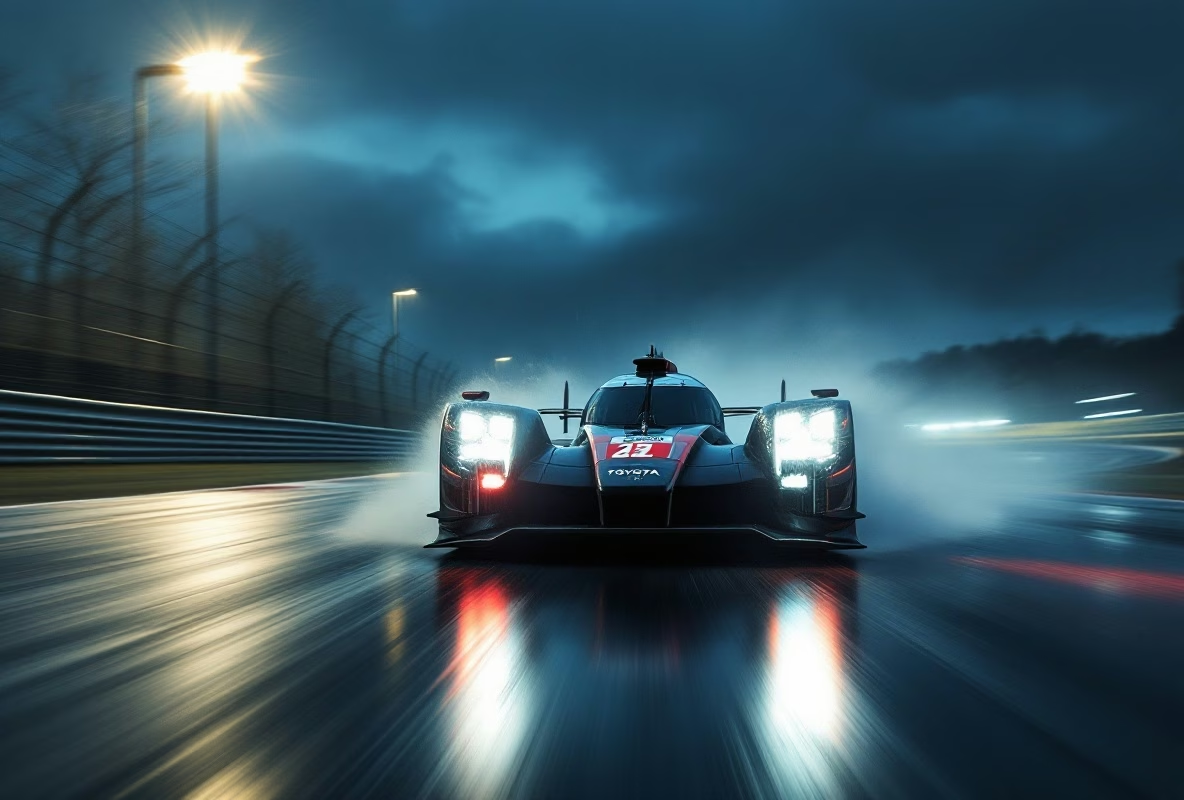
Picture it: P3, rain incoming, headlights from five cars filling your mirrors. Then: 38 FPS. Down from 110. No warning, no crash. Just a stuttering slideshow while you turn into the Porsche Curves on wet, reflective tarmac.
Sound familiar? During the day, Le Mans Ultimate runs fine. The sun sets, and your framerate goes down with it. And no, it’s not necessarily your graphics card’s fault. It’s how LMU (built on the old but still surprisingly demanding rFactor 2 engine) handles light in the dark.
Let’s actually fix this. Not with “turn everything to low” advice, but with targeted changes that bring your framerate back without making your race look like a PS2 title.
The Real Villain: It’s Not Your GPU, It’s Light
During the day, your PC mostly renders objects with static lighting. Basically one light source: the sun. At night, your system has to calculate dynamic lighting for every source: headlights, grandstand lights, track lighting, reflections on wet asphalt. And it does this every single frame, for every car on track.
With twenty-plus cars all casting headlight shadows and bouncing light off the road surface, you’re asking your system to do something completely different from a sunny afternoon in Bahrain. That’s the core of the problem. Not a weak GPU. It’s how LMU calculates lighting once it gets dark.
And here’s the part people miss: the settings that barely matter during the day become the biggest FPS killers at night.
The Settings That Actually Move the Needle
Tackle Environment Reflections First
This one’s number one. Reflections on wet or dark road surfaces get expensive fast at night, because every light source needs to be reflected separately. Drop Environment Reflections one or two notches below what you’d run during the day. Visually you’ll barely notice. The reflections are still there, just rendered a bit less crisply. Your framerate, though? It’ll notice. A lot.
Shadows: Lower Than You Think You Need
Shadow quality set to High or Ultra means every car with working headlights casts real-time shadows onto the track, tire marks, and run-off areas. During the day that’s one light source (the sun) to account for. At night, that’s dozens. Drop Shadow Quality to Medium. Seriously, test it yourself: you won’t see the difference in your mirrors. You will see it on your FPS counter.
Tone Down Headlight Glow and Bloom
Post Effects and Bloom create those pretty halos around headlights and streetlights. Gorgeous in a screenshot. Expensive on your rig, especially combined with rain. Drop Post Effects to Medium and check if Bloom is adjustable separately. If not, it’s usually tied to your overall Visual Effects level.
Particle Effects and Track Lighting
Raindrops catching headlight beams, dust particles lighting up in a headlight cone, exhaust glow. That’s all Particle Effects. In night races with rain (the exact combination people complain about most), this is one of the priciest settings you’ve got. Drop it one step and you’ll barely notice visually, except that your car stops hitching every time you turn into a corner.
The AI Grid Problem Nobody Talks About
Here’s where people get stuck even after tweaking every setting: grid size. Every AI car with working headlights is another light source your system has to calculate, complete with shadows and reflections that car casts onto everything else.
A 20-car grid during the day? No problem. A full 30+ car grid, at night, in the rain? Completely different beast. Try running a smaller grid (say, 16 cars instead of 32) during a night practice session. If your FPS jumps, you’ve found your actual bottleneck. Then you can decide whether you’d rather race a smaller field or dial back other settings even further.
Driver and Windows Tweaks People Skip
Set a Frame Rate Cap
Sounds counterintuitive (limiting your framerate to perform better), but it works. Set a frame limiter just under your average (say, 90 if you normally swing between 90 and 140) using RTSS or the in-game limiter. This kills the sharp spikes and drops that make stuttering so noticeable in the first place. A steady 90 FPS often feels smoother than a jumpy 60-140.
Turn On Low Latency Mode or Anti-Lag
If you’re running a modern GPU, enable Low Latency Mode (Nvidia) or Anti-Lag (AMD) in your driver settings. This won’t magically speed up the game, but it cuts input delay that becomes way more noticeable at lower framerates. It makes low FPS feel less rough even when the number itself hasn’t changed much.
Windows Game Mode and Background Processes
Boring advice, but it works: close Discord overlays, streaming software, and browser tabs before you race. rFactor 2-based engines are notorious for leaning hard on single-thread CPU performance. Any background task hogging that one core comes straight out of your framerate.
Where NOT to Waste Your Time
A lot of forum advice jumps straight to lowering resolution. Don’t do that first. Resolution has relatively little impact on this specific night-race problem, because most of the load comes from dynamic lighting calculations, not pixel count. You’ll trade sharpness for a marginal gain.
Same goes for switching off Anti-Aliasing entirely. It helps a bit, but the jagged edges you get in return stand out way more at night against dark backgrounds. The exact opposite of what you’re after.
And no, buying a new GPU isn’t step one. I get the temptation, but if your card handles 90+ FPS fine during the day and tanks at night, that’s a software problem, not a hardware one. Fix the settings first. Look at upgrades after.
The Hardware Reality Check (If Settings Aren’t Enough)
If you’ve applied all the tweaks above and still drop below 60 FPS during rainy night races, you’re probably hitting a CPU bottleneck. rFactor 2-based titles lean heavily on single-thread CPU performance, more than a lot of newer game engines. A strong GPU only gets you so far here.
Watch your per-core CPU load while racing (Task Manager or MSI Afterburner both work). If one core’s pinned at 95-100% while your GPU sits at 60%, that’s your bottleneck right there. In that case, a faster CPU (higher single-core clock speed) is a more effective upgrade than a pricier graphics card.
Quick Checklist for Your Next Night Race
- Environment Reflections down one or two notches
- Shadow Quality set to Medium
- Post Effects/Bloom toned down
- Particle Effects lowered, especially in rain
- Test smaller AI grids
- Set a frame rate cap via RTSS or in-game
- Enable Low Latency Mode / Anti-Lag
- Close background processes
- Only then: consider hardware upgrades
Night races in LMU are, honestly, the best thing this game has going for it: the wall of headlights lighting up the Mulsanne Straight, glossy wet tarmac, that full Le Mans atmosphere. It’d be a shame to only experience that through a slideshow of disconnected frames. Adjust these settings, test them on your own rig, and get back out there. Those 24 hours won’t wait.