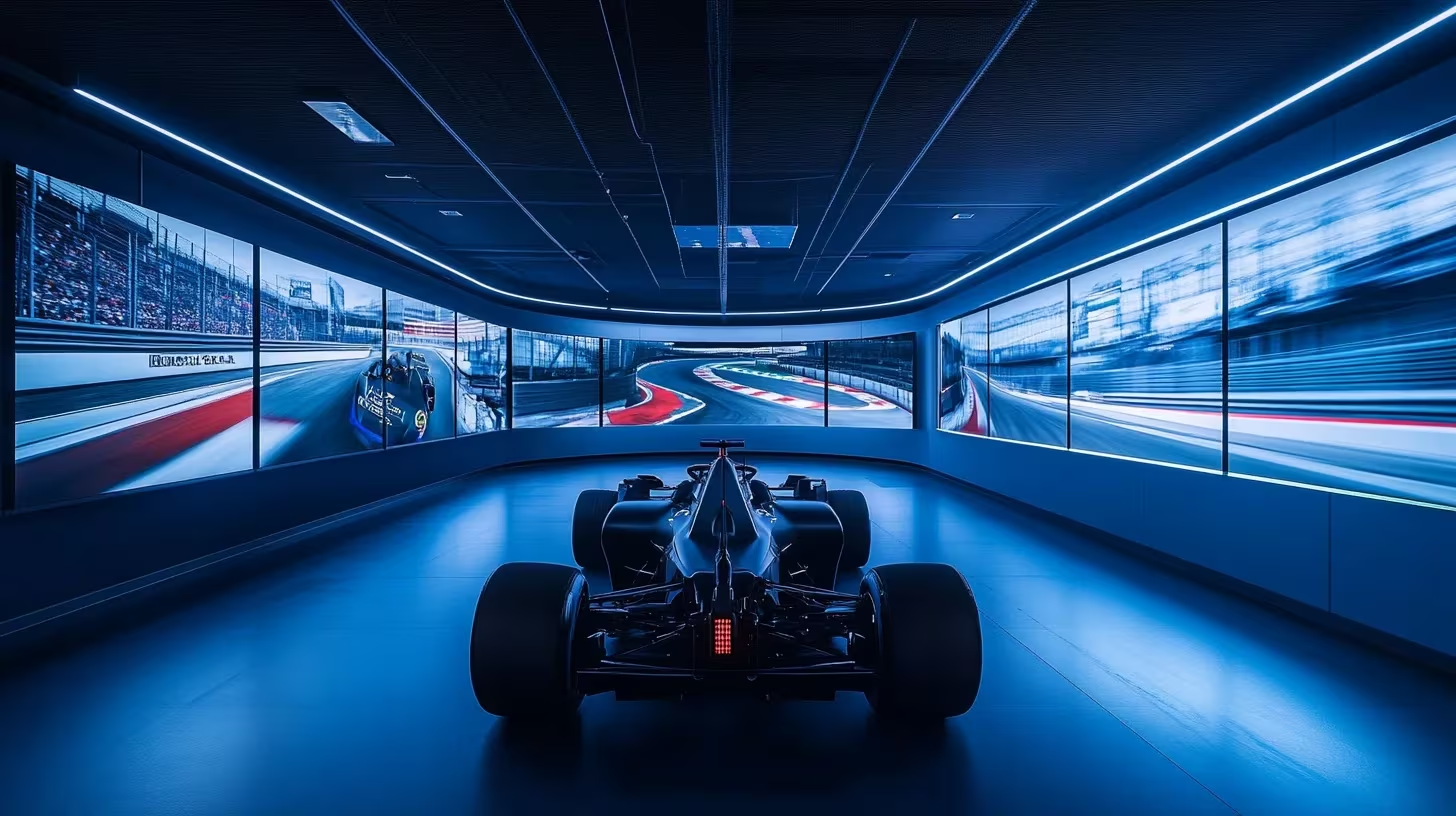
The Secret Weapon of Verstappen and Hamilton: Why F1 Teams Spend Millions on Virtual Racing
Whilst you’re reading this, somewhere an F1 driver is virtually racing hundreds of laps, and it could make the difference between victory and defeat on Sunday.
Formula 1 teams now invest tens of millions in state‑of‑the‑art simulator labs. What once began as simple racing games has evolved into the beating heart of F1 development. From Ferrari’s brand‑new ‘generation leap’ simulator to Mercedes’ night‑time sim sessions that save races – the virtual world increasingly determines who ends up on the podium.
The Technology: So Real Your Brain Doesn’t Know the Difference
Modern F1 simulators are no longer games. The driver sits in an exact replica F1 cockpit, surrounded by screens offering a 360‑degree circuit experience. The secret? An electro‑mechanical motion platform with six degrees of freedom that can heave, roll and yaw. Every braking action, every kerb is physically felt. Force‑feedback steering wheels deliver exactly the same vibrations as in the real car. The result: your brain genuinely thinks it’s racing.
But the real magic lies in the software. Ferrari’s new Dynisma simulator achieves a latency of just 3 to 5 milliseconds, where older systems sat around 20 to 30 ms. With more delay, a driver can’t realistically react to breaking rear wheels, resulting in spins.
And then there’s AI. Teams use machine learning to calculate thousands of race scenarios in seconds: different pitstop timings, tyre degradation, weather changes. The computer literally plays out thousands of possible races to find the optimal strategy.
For Drivers: Unlimited Practice Without Risk
In the simulator there’s no tyre wear, no fuel consumption, no bad weather. Rookies can “learn” new circuits for hundreds of laps before they ever drive there for real.
Max Verstappen is the perfect example. According to former driver Gerhard Berger: “Max is constantly in the simulator, sometimes three races a day. He therefore thinks continuously about where you can overtake and where not. Senna, Schumacher nor Hamilton had that tool at their disposal.”
But it goes beyond just driving. F1 drivers must also master procedures: managing hybrid ERS systems, running through start procedures, switching engine modes per corner. Everything can be practised until it becomes second nature – risk‑free.
The Mercedes Example: From Disaster to Podium in One Night
The 2023 Spanish GP shows the power of simulators. Mercedes struggled with a poorly balanced car on Friday. That night, reserve driver Mick Schumacher dove into the Brackley simulator. His “tremendous work” helped the team get the setup into the right window, resulting in a double podium on Sunday. Lewis Hamilton praised the simulator overnight programme: the W14 suddenly felt much better.
For Teams: Virtual Development Saves Millions
Testing Parts Before They Exist
Teams can test new front wings, suspension or diffusers virtually first. The driver gives feedback as if trying the real component. Does an update work? Only then is the physical part manufactured.
Rob Smedley, former F1 engineer: “If the simulations match reality, you can trust the simulator environment – it’s much cheaper to find performance in the computer than on the tarmac.”
The Correlation Process: The Holy Grail
The simulator is only valuable if it matches reality. That’s why teams constantly compare simulation data with real car data. This is called correlation. A well‑correlated simulator means confidence: every virtual improvement translates to real speed on Sunday.
Smedley: “When your correlation doesn’t match, it’s the biggest pain there is – instead of spending time on development, you’re deploying all your engineers to find the mismatch.”
The Million‑Pound Investments: Examples from Top Teams
Ferrari’s Generation Leap
Ferrari struggled with correlation problems for years. That’s why between 2019 and 2021 they built a completely new simulator at their Fiorano test facility, in collaboration with British firm Dynisma. The project took two years and cost millions.
Gianmaria Fulgenzi of Ferrari: “Simulation and digital technology are going to play an increasingly important role in the development of an F1 car.” The new simulator runs on cutting‑edge motion‑platform technology and should give Ferrari an advantage under the modern regulations.
Mercedes’ Sim Programme
Mercedes is known as a leader in simulation. The team has dedicated simulator drivers – former racers like Stoffel Vandoorne and Mick Schumacher who do full‑time sim work. Even Lewis Hamilton, who previously didn’t spend much time in the sim, started doing extra sessions during the 2021 title fight: “I’ll continue to work [in the sim]… overall it’s been positive.”
Red Bull’s Virtual Edge
Red Bull invests heavily in simulation, contributing to their successful run. The team regularly manages to stay a step ahead with razor‑sharp strategies and car setups. In 2022 they even signed Rudy van Buren – winner of McLaren’s “World’s Fastest Gamer” esports competition – as a development driver on the simulator.
From Gaming to F1: The Sim Racing Revolution
F1 simulators have also had a noticeable impact on the sim racing world. Since 2017, Formula 1 has had an official F1 Esports Series. Teams have dedicated e‑sports squads and see it as a new talent pool.
Rudy van Buren won McLaren’s “World’s Fastest Gamer” in 2017 and became official simulator driver at McLaren. In 2022, Red Bull Racing signed him as simulator test and development driver. From sim racing in the living room to being part of an F1 team – something like that was unthinkable a decade ago.
F1 drivers themselves also embrace sim racing. Verstappen is so passionate that fans see him competing on iRacing in the evenings, sometimes in 24‑hour sim races. Lando Norris regularly streams his virtual racing adventures on Twitch.
The Downside: Can Simulators Do Everything?
Despite all the advantages, critics remain. Carlos Sainz recently pleaded for more real test days: “As good as the simulators are, they’re not as good as some engineers think. Teams spend endless amounts on sims and fly drivers to the factory, whilst that budget might be better spent on a few extra test days.”
He has a point: the physical world always contains the ultimate truth. But within F1’s strict testing limits, simulators have become an indispensable alternative.
Conclusion: Necessity, Not Luxury
The million‑pound investments in simulation training labs have become a necessity for F1 teams, not a luxury. The continuous technological progress – from lifelike hardware to intelligent AI analyses – enables teams to develop virtually what they’re not allowed or able to do in reality.
Drivers stay sharp and learn circuits on the simulator. Teams develop faster and smarter. And the whole sport becomes more competitive because of it. Moreover, the influence extends beyond F1’s boundaries: the sim racing world thrives on the connection with the pinnacle class, and new talent can make the step up through digital pathways.
Today’s F1 simulator is a win‑win innovation: it’s both an indispensable tool in the title fight and a bridge between virtual and real racing. An investment that’s worth its millions twice over – and that could make the difference on Sunday between P1 and P2.
Recommended Hardware for Home
Want to translate the insights from this article to your own rig? Check out our reviews of proven hardware from the sim racing world: