In 2025, nearly 1 in 3 sim racers drives in VR – but is that also the best choice for you?
The days of racing on one standard screen are over. Modern sim racers have a choice of triple-monitor setups, ultrawide monitors or VR headsets. Each option offers a different level of immersion, performance advantage and convenience. In 2025, an estimated ~33% of sim racers drive in VR, ~14% with triples and ~26% with an ultrawide. But which setup fits your style and budget?
Triple Monitor: Maximum Overview
The Experience
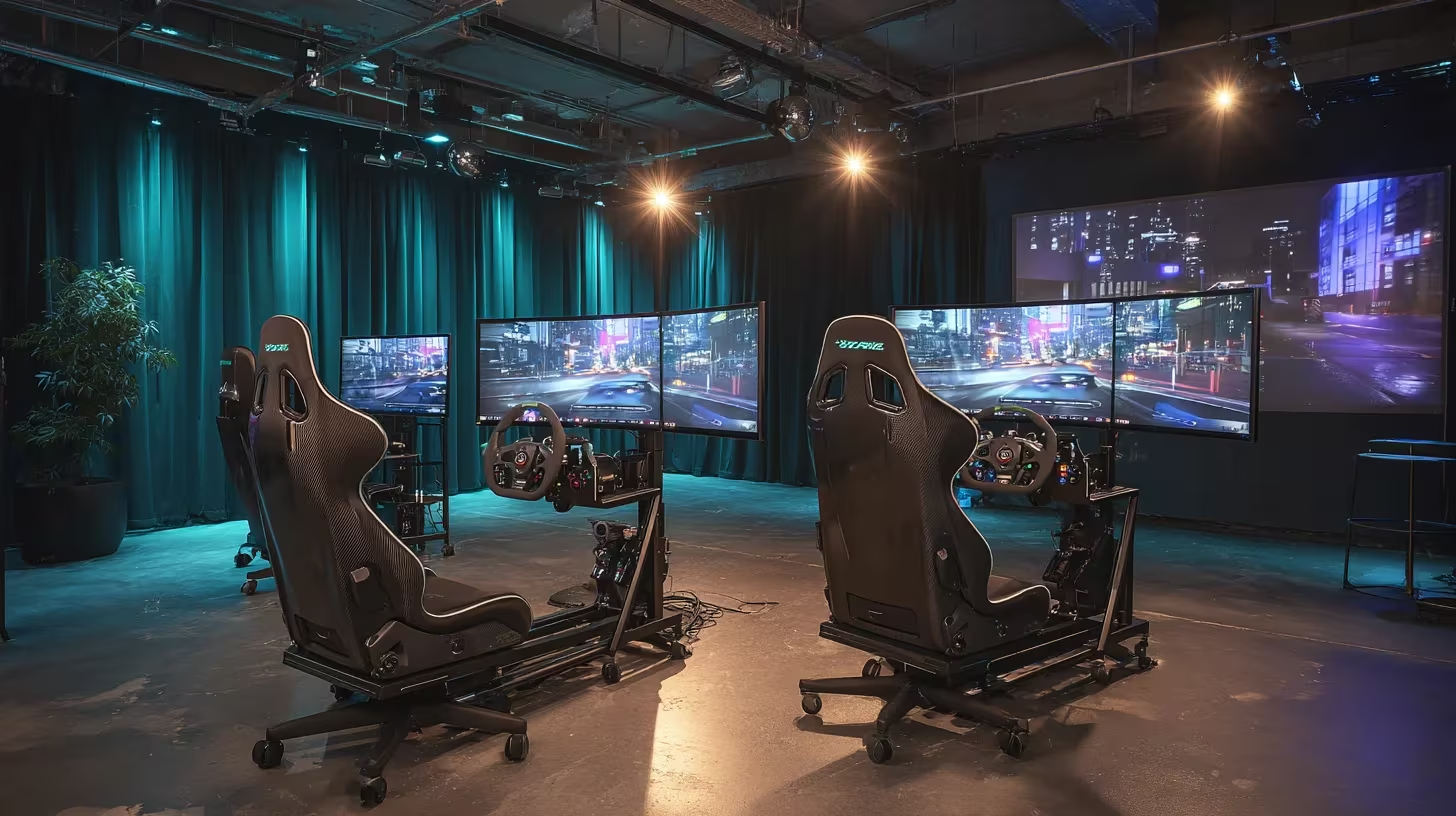
Three monitors around give a field of view of about 160° – almost your full peripheral vision. You see approaching corners on the side screens without turning your head, and cars next to you simply appear in your field of view. It’s still 2D (no real depth), and the monitor bezels interrupt the image, but most racers get used to this quickly.
Competitive Advantage: Excellent situational awareness. You see opponents, apexes and exit points without artificial look-to-apex functions. Many pro sim racers and league drivers choose triples for that constant visual information. High refresh rates (144Hz+) ensure low input lag.
Comfort: Very comfortable – nothing on your head, no motion sickness. You can easily see your button box, shifter and drink. It does require space: three screens plus a sturdy stand. Once set up, it’s plug-and-play.
Price: The most expensive option. Three 27” 1440p 144Hz monitors cost €750-€1500. Plus a monitor stand (€100-300) and a powerful GPU to drive all the pixels. Think at least an RTX 4070 or better.
Recommended Setup:
- Budget: 3x AOC 24G2 (24” 1080p 144Hz) – ~€450 total
- Mid-range: 3x ASUS TUF VG27AQ (27” 1440p 165Hz) – ~€900 total
- High-end: 3x Samsung Odyssey G7 (27” 1440p 240Hz curved) – ~€1350 total
- Stand: Next Level Racing Triple Monitor Stand (~€250)
Compatibility: Excellent in iRacing, Assetto Corsa (Competizione), rFactor 2, Automobilista 2. Only PC – consoles don’t support triple-output.
Ultrawide Monitor: The Golden Middle Ground
The Experience
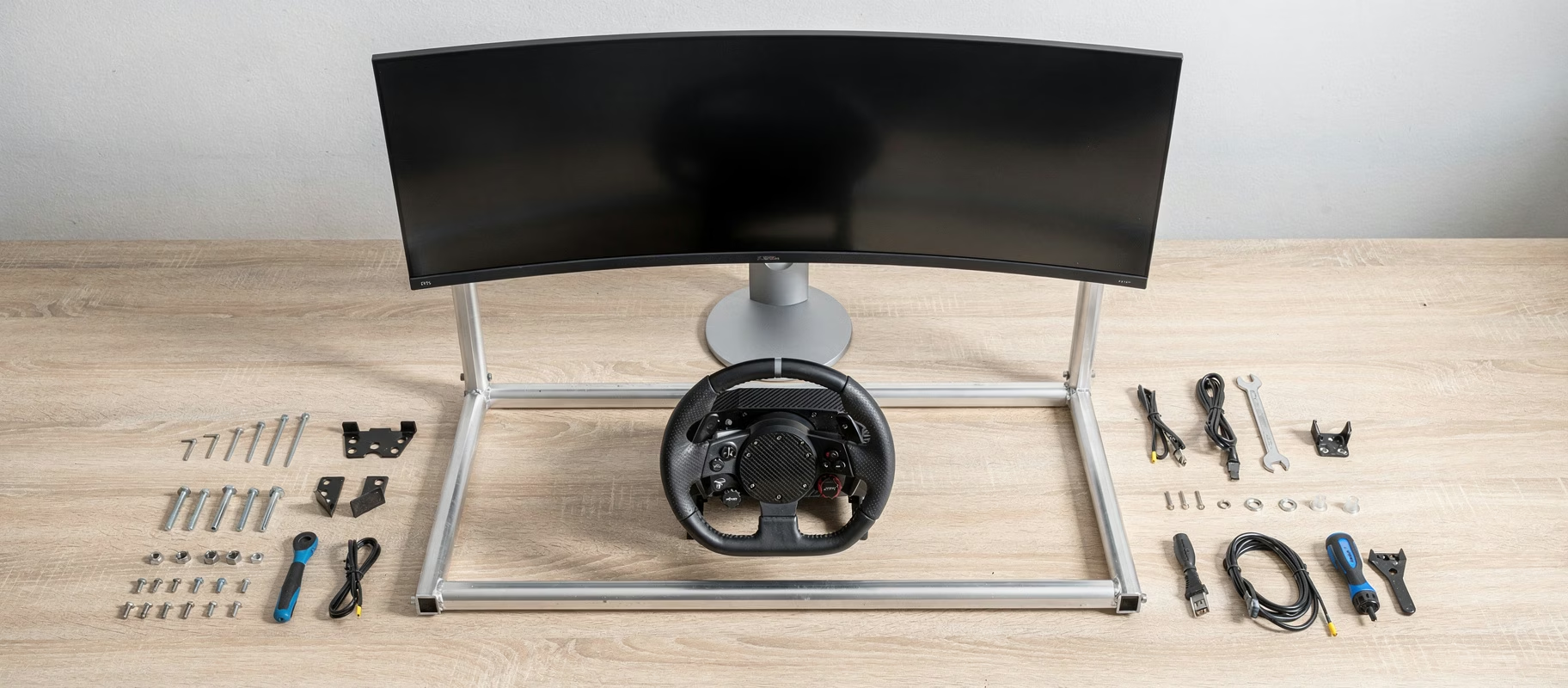
An ultrawide (21:9 or 32:9) gives you wider vision than standard, but in one seamless image without bezels. A curved 49” ultrawide partly wraps around your field of view (~90-120° effective FOV). No monitor bezels, but also no 160° like with triples. Often sharper images than VR thanks to higher resolution.
Competitive Advantage: Good overview – apexes and mirrors are more visible than on 16:9. You react faster, but have slightly less peripheral vision than triples. For most drivers, an ultrawide performs comparably. High refresh rates (100-240Hz) are available.
Comfort: Just as comfortable as a normal monitor. No headset, no sickness risk. Takes less space than triples – one screen on a sturdy arm. Perfect with limited space.
Price: Middle class. A decent 34” 21:9 costs €500-€700, a 49” super-ultrawide €1000-€1200. GPU load is significant but lower than triples. An RTX 4060 Ti or 4070 often suffices for 3440×1440.
Recommended Models:
- Budget: LG 34WP65C-B (34” 21:9 1440p) – ~€400
- Mid-range: Gigabyte M34WQ (34” 21:9 1440p 144Hz) – ~€500
- High-end: Samsung Odyssey G9 (49” 32:9 1440p 240Hz) – ~€1100
- Premium: Samsung Odyssey Neo G9 (49” 32:9 MiniLED) – ~€1800
Compatibility: Virtually universal. All modern sims support 21:9 and 32:9 resolutions out-of-the-box. On consoles often limited to 16:9.
VR: Ultimate Immersion
The Experience
Virtual reality literally places you in the cockpit. Stereoscopic 3D image gives real depth – distances and speed feel realistic. You can freely look around by moving your head, as if you’re really sitting in the car. The field of view (~100-120°) is smaller than triples, but the immersion surpasses everything.
Competitive Advantage: Depth perception helps with judging braking points and apexes. Many VR drivers position their car more precisely thanks to 3D vision. There is a learning curve – you’re initially slower until you’re used to it. After that, potentially just as fast or faster thanks to better spatial insight.
Comfort: The challenge. VR headset adds weight (~400-600 grams), gets warm, and some get motion sickness. Sessions longer than 1-2 hours can be tiring. You’re completely isolated from the outside world – increases focus, but operating real buttons goes blindly. Starting up takes time (headset, software, tracking).
Price: Surprisingly competitive. A good VR headset costs €400-€800, often cheaper than triples. You do need a powerful GPU (RTX 4070+ for good experience). For PS5 users, PSVR2 (~€550) is the only option for immersion in Gran Turismo 7.
Recommended Headsets:
- Budget: Meta Quest 2 (with Link cable) – ~€300 used
- Best Value: Meta Quest 3 (standalone + PC VR) – ~€550
- High Res: HP Reverb G2 (2160×2160 per eye) – ~€600
- High Refresh: Valve Index (144Hz, excellent tracking) – ~€1050
- Premium: Pimax Crystal (2880×2880, wide FOV) – ~€1600
- Console: PlayStation VR2 (PS5 only) – ~€550
Compatibility: Increasingly broader. iRacing, Assetto Corsa (Competizione), rFactor 2, Automobilista 2 have excellent VR support. On console only PS5 + PSVR2 for GT7.
Hardware Recommendations: Complete Setups
Entry-Level (€500-€1000)
Monitor Route:
- LG 34WP65C-B Ultrawide (~€400)
-
- Fanatec CSL DD 5 Nm bundle (~€500)
- GPU: RTX 4060 Ti
VR Route:
- Meta Quest 3 (~€550)
-
- Moza R5 Bundle (~€500)
- GPU: RTX 4070
Mid-Range (€1500-€2500)
Triple Route:
- 3x ASUS TUF VG27AQ (~€900)
-
- Next Level Triple Stand (~€250)
-
- Fanatec ClubSport DD 12Nm (~€700)
- GPU: RTX 4070 Ti Super
Ultrawide Route:
- Samsung Odyssey G9 (~€1100)
-
- Moza R9 Bundle (~€800)
- GPU: RTX 4070 Ti
High-End (€3000+)
Triple Route:
- 3x Samsung Odyssey G7 (~€1350)
-
- SimLab Triple Mount (~€400)
-
- Fanatec Podium DD1 (~€1200)
-
- Fanatec ClubSport Pedals V3 (~€360)
- GPU: RTX 4080 Super
VR Premium:
- Pimax Crystal (~€1600)
-
- Moza R12 + pedals (~€1400)
- GPU: RTX 4090
Which Do You Choose?
Choose Triple Monitor if: ✅ You want maximum overview ✅ You race in leagues or drive competitively ✅ You have space and budget ✅ You want long sessions without head weight
Choose Ultrawide if: ✅ You’re looking for the best balance (immersion + convenience) ✅ You have limited space ✅ You want one screen for everything (work + games) ✅ You want plug-and-play without hassle
Choose VR if: ✅ Maximum immersion is your priority ✅ You have little physical space ✅ You don’t suffer from motion sickness ✅ You want the “really sitting in the car” experience ✅ You race on console (PS5)
Community Consensus
In forums and Reddit you see that opinions differ, but some trends are clear:
“VR > Triples > Ultrawide” for pure experience – VR gives the most impression, triples offer the best overview, ultrawide is the practical middle ground.
“Once you go VR, you can’t go back” – many VR users say that monitors feel flat afterward. At the same time, pros often keep triples for reliability.
Ultrawide is “good enough” – some who tried triples noticed they mainly used the middle screen anyway. A large ultrawide gives 75% of the advantages with 50% of the hassle.
Conclusion: Your Perfect Setup
There is no “best” choice – only what fits you best. Have the space and budget? Triples offer unmatched overview. Want simplicity and a large image? Go for a solid ultrawide. Looking for the ultimate “I’m sitting in the car” experience and willing to accept some discomfort? VR is your thing.
What is certain: each of these options beats a standard 16:9 monitor by miles. The investment in triple, ultrawide or VR lifts your sim racing to a higher level. Your lap times will improve, your racing pleasure doubles, and your friends will be jealous.
Ready to upgrade? Check our complete sim racing setups on mysimrig.nl!
All prices are indicative and may vary per supplier.