The honest answer first
A fully DIY motion system that’s safe, stays mobile, and works for both racing and flying isn’t a weekend project. There’s simply no proven build plan for it. What does work: buy a commercial motion platform, put it in a modular, movable frame, then mount your own wheelbase and, for flying, a HOTAS or yoke. Boring? A little. But it’s the only route where manufacturers actually publish real specs.
The question “how do I build a mobile motion cockpit” usually comes out of long forum threads full of ambitious builds. They mostly show how many people want this. They don’t prove there’s one reliable, copyable build method. Treat community builds as inspiration, not an instruction manual. Especially for the parts that move.
Mobile and motion don’t get along
These two requirements pull in opposite directions, which is why this is harder than a normal cockpit build:
- Motion means your seat (or your whole cockpit) physically moves based on what happens in the game: pitching under braking, rolling in corners, jolts over kerbs. That demands a stiff frame that doesn’t flex and a platform that can carry your weight plus the seat’s.
- Mobile means you can move, fold, or store the cockpit. That demands a light frame you can take apart quickly.
Heavy and stiff versus light and foldable. You can’t max out both, so you pick which one matters more.
Two routes, but I’d only recommend one
1. An off-the-shelf seat mover plus a sturdy frame (where I’d start)
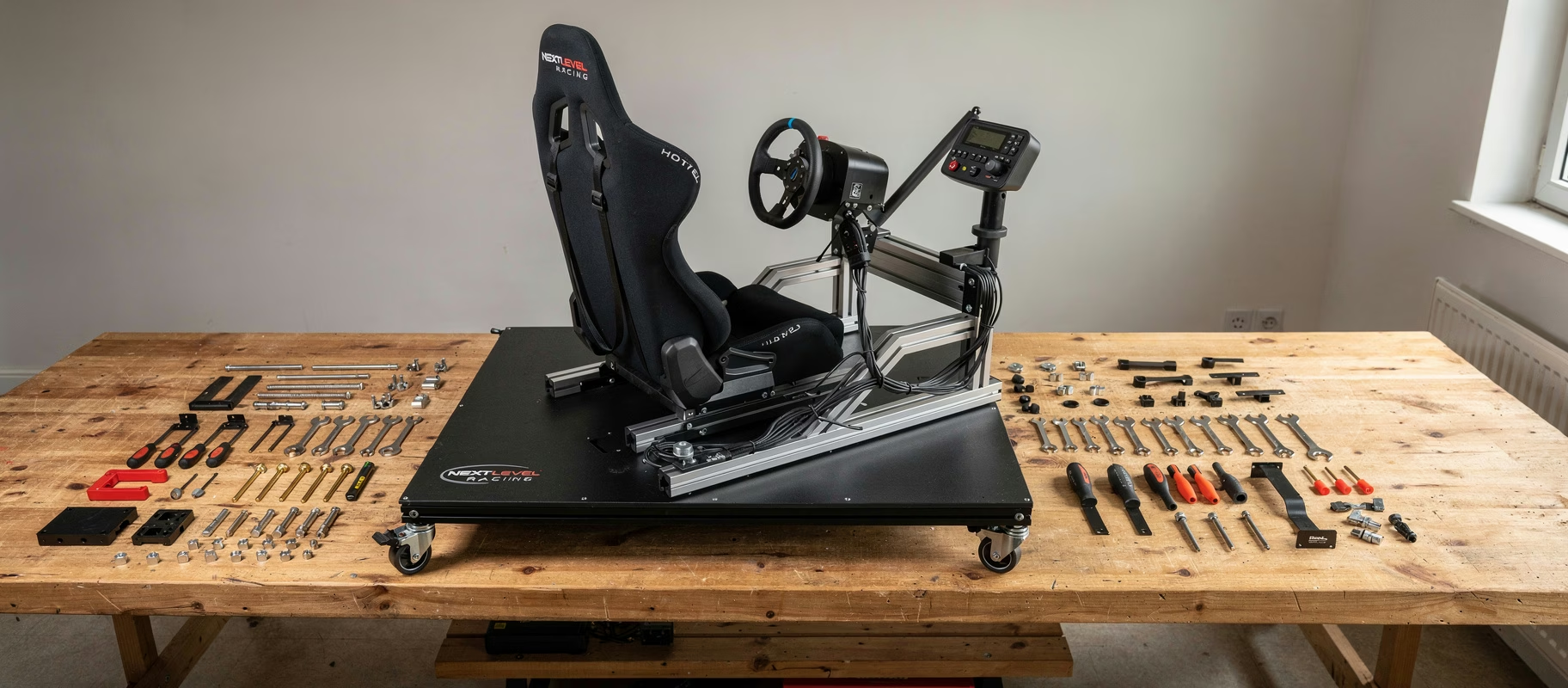
This approach actually has documentation behind it. Take the Next Level Racing Motion Platform V3. It’s a 2DOF seat mover: it tilts your seat in pitch and roll (up to about 10 degrees each way) while your wheel and pedals stay put. Max user weight is 130 kg, and according to Next Level Racing the software supports both racing and flight sims (Next Level Racing support). For a rig you want to race and fly in, that’s exactly what you’re after.
There’s a catch, though. Officially, the V3 fits Next Level Racing’s own cockpits out of the box, like the GTtrack, the F-GT Elite series and the Flight Simulator Pro. The GTElite and F-GT Elite Lite also need the Elite Motion Adaptor Upgrade Kit.
Prefer a modular aluminium frame? Sim-Lab, for example, has the Sim-Lab P1X Pro, with a modular design, broad wheelbase support, and room for heavy pedals. The Sim-Lab GT1 Evo from the same brand scales from a basic setup up to a premium build and supports Sparco seats, among others. There are videos online of people fitting a V3 to a GT1 Evo, but neither Next Level Racing nor Sim-Lab lists that pairing as officially compatible. So ask both of them whether the mounting points line up before you order.
2. Full DIY with actuators
This route gets the most attention in build threads. It’s also the one I can’t hand you a reliable, uniform build guide for. A DIY motion rig usually consists of:
- Linear actuators, or motors with lever arms, for two or three axes of movement
- A motor controller and power supply that can handle high current and serious loads
- Software that turns simulator telemetry into motion commands
- A frame that absorbs torsion and vibration without shaking itself loose
Bolt sizes, materials, current ratings and safety measures differ from project to project. Without a verified plan for your exact parts, I’m not going to give you dimensions, bolt sizes or wiring diagrams. That would be irresponsible. Anyone taking this route needs real electrical and structural engineering knowledge, not a generic guide.
What you need for racing and flying
Frame and mounting points
Your frame needs holes or rails for a wheelbase and for a HOTAS or yoke, plus rudder pedals next to or instead of your racing pedals. Not every racing frame comes with ready-made mounting points for that. Not spelled out in the specs? Ask. Don’t need motion and mostly care about folding it away? Then the options are in the best mobile cockpit for racing and flying.
Seat
With a seat mover, the platform carries your seat, so a sturdy bucket seat makes sense. The Sim-Lab Speed 1 Bucket Seat is a fixed fibreglass bucket with memory foam, available in a standard size (for M and L drivers) and an XXL version. Brackets and slider aren’t included, so budget for those.
Mainly want something you can move around, and don’t need motion (yet)? The Playseat Sensation Pro is a complete, fully adjustable steel cockpit with ActiFit fabric. According to Playseat it measures 150 x 63 x 94 cm, weighs 38 kg, and is rated for drivers up to 120 kg (some retailers list 122 kg). It doesn’t fold. So “mobile” here means you can slide it around, not stash it in a cupboard.
Wheel and pedals
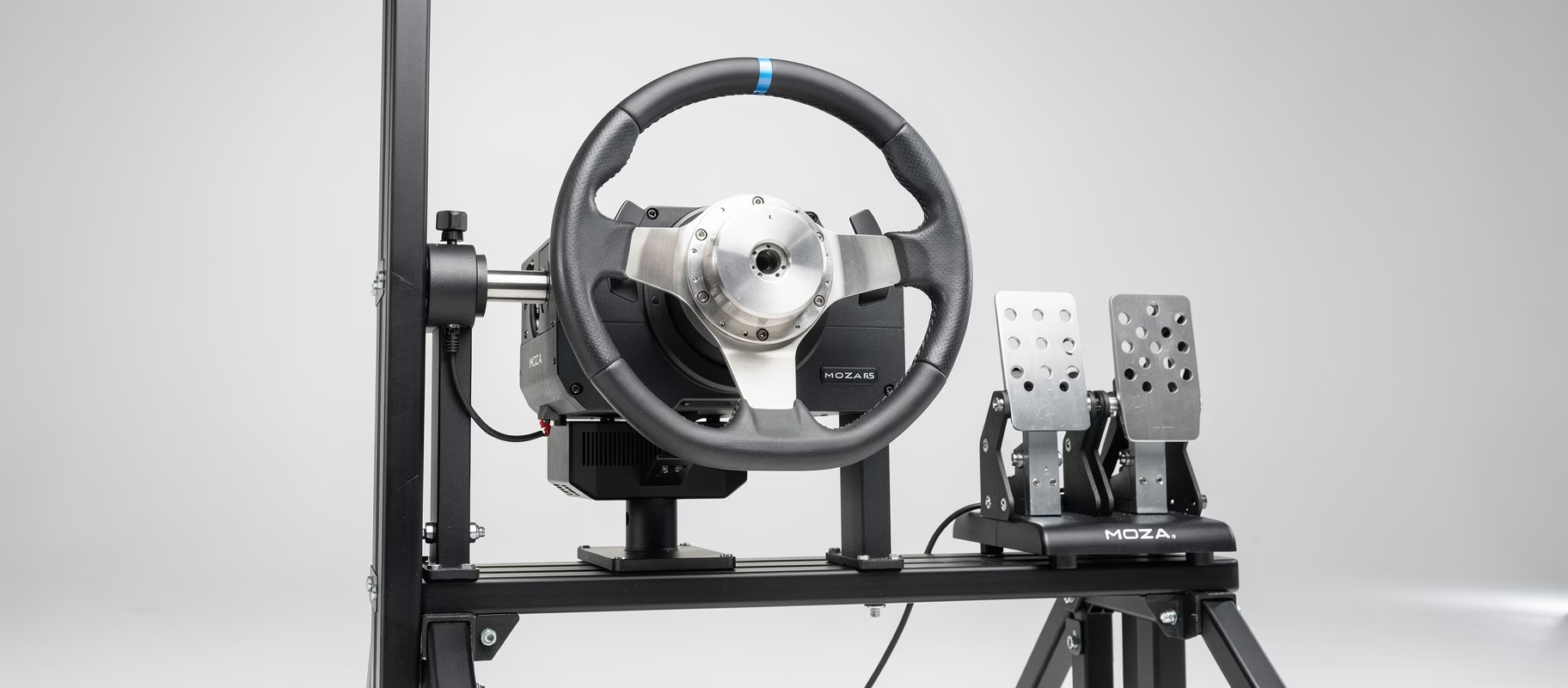
For the racing side you need a direct-drive base and a wheel. The Moza Racing GS V2P GT is one such wheel: 300 mm, forged carbon, magnetic shifter paddles. It gets power and signal through the wired (slip-ring) quick release of a compatible MOZA base, with no battery inside. According to MOZA it doesn’t work with older MOZA bases that use wireless transmission (R9, R16 and R21 V1), so check your base before ordering.
Casters, hinges and weight
In practice, mobility comes down to three things: weight, casters or a dolly, and a frame you can take apart with a few bolts instead of welding or gluing. The V3 alone already weighs around 25 kg. If a manufacturer says nothing about moving the product around, don’t assume it’s built for it.
Why there’s no priced shopping list here
A good build guide should come with a priced breakdown. You won’t get one here, and that’s deliberate. Prices for motion platforms and frames vary by retailer and country and shift regularly. I’d rather not quote a figure that’s wrong next month. Check the current price on the product pages above or with the retailer, and on top of the platform and frame, budget for a wheelbase, pedals, a HOTAS or yoke, mounting brackets and cross-brand adapters. It’s the small parts that add up faster than you’d think.
Checklist before you start
- Choose first: motion or mobile. Do you mainly want to move it around, or mainly want to feel real motion? You can’t max out both.
- Motion platform first, then the frame. Confirm mounting points and max weight with the manufacturer before you buy a frame.
- Ask explicitly about flight-sim mounting points. Not every racing frame can take a HOTAS or yoke alongside a wheel.
- Budget for adapters and brackets. Mixing brands (say, a Sim-Lab frame with a Moza base) often works, but sometimes needs extra hardware that isn’t in the box.
- Don’t build your own actuator system without electrical engineering experience. Current, weight and vibration are real risks. Only with documented, verified plans.
Who this is for
Experienced sim racers and flight simmers who already know their way around aluminium profile systems and are willing to invest in a separate motion platform plus an adjustable frame. Beginner? Start with a fixed, non-motion cockpit like the Playseat Sensation Pro and expand later. And if you’re set on a DIY rig with home-built actuators, know that there’s no universal, safe build guide for it. Just individual community projects, each with its own materials, budget and risk.
What I’d do
If I wanted to race and fly with motion, I’d pick a seat mover like the Next Level Racing V3 in a cockpit it’s officially made for, and check every extra part for compatibility myself. A fully home-built actuator system is technically possible. It’s just not a weekend project anymore. It’s an engineering project.