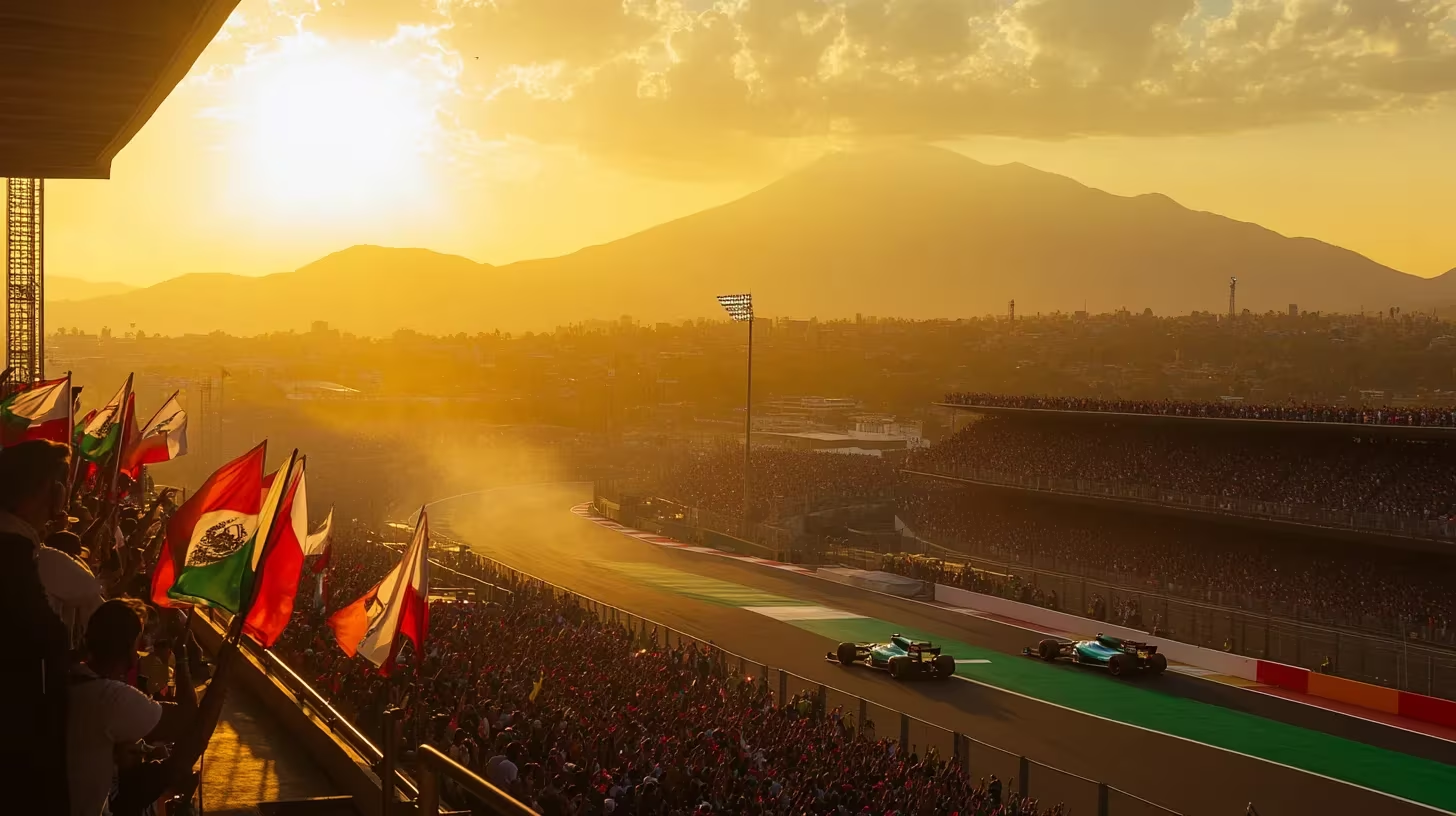
At 2,200 metres altitude, everything could change this weekend in the F1 championship
With only five races to go, Formula 1 is on a knife‑edge. Oscar Piastri, Lando Norris and Max Verstappen stand within forty points of each other. At the high‑altitude Autódromo Hermanos Rodríguez in Mexico City, the title fight could take a decisive turn this weekend.
The Standings: It Couldn’t Be Tighter
Championship Top 3:
- Oscar Piastri (McLaren) - 346 points
- Lando Norris (McLaren) - 332 points (+14)
- Max Verstappen (Red Bull) - 306 points (+40)
McLaren dominates the constructors’ with 678 points – the title is virtually sealed. But in the drivers’ championship? That’s a different story.
Crucial Scenarios
McLaren Team Battle: After their crash in Austin both drivers got a ‘clean slate’ – they’re free to race, as long as they don’t hit each other. If Piastri wins and Norris retires, his lead grows to ~39 points. Conversely, Norris can take the lead with a victory.
Verstappen’s Comeback: Max has clawed back 64 points on Piastri in four races. A win here (his sixth in Mexico!) plus McLaren misfortune could bring him to within ~15 points. Hamilton has already warned the McLaren lads: don’t underestimate a reborn Verstappen.
Piastri’s Chance: With a victory the Australian’s lead grows towards 35+ points. Not enough to decide it, but a psychological statement.
Mexico: The Most Extreme Circuit
Thin Air at 2,200 Metres
No F1 circuit sits this high. Air pressure is 20% lower than at sea level, with bizarre effects:
The paradox: Cars run with Monaco‑level downforce but reach Monza speeds. How? Air resistance also drops in thin air. Result: only 78% of normal grip – the machines slide across the tarmac.
Cooling Nightmare: Less air means less cooling for engines, brakes and hybrid systems. Teams have brought special cooling openings. Ferrari admits this costs aerodynamic efficiency, but reliability comes first.
Engine Stress: Turbos spin at full tilt to generate power. Teams often deploy fresh engine components to prevent failures.
The Circuit
The Straight: At 800+ metres, one of the longest in the world. Bottas once recorded 372 km/h here – an F1 record. Slipstream is king, so pole position is worth less here. The braking zone into Turn 1: from ~350 km/h to ~100 km/h in seconds.
Foro Sol Stadium: Drivers race through an arena packed with 140,000 ecstatic Mexican fans. The ground vibrates from the cheering.
Tyre Strategy: Pirelli selects C2 (hard), C4 (soft) and C5 (supersoft). One‑stop or two‑stop? Graining is historically a problem. Expected temperature: sunny 26°C.
Verstappen: King of “Maxico”
Max has won here five times (2017, 2018, 2021‑2023) – a record. The race is nicknamed “GP of Maxico” due to his dominance. Even now he’s the top favourite, despite McLaren’s faster car.
Other highlights:
- Hamilton won in 2016/2019 and clinched the title here in 2017/2018
- Sainz surprised with victory in 2024
- Sergio Pérez became the first Mexican to reach the podium (2021, 2022)
Checo’s Drama: Pressure That Backfires
Pérez is a national hero in Mexico. But in 2023 the pressure turned into disaster. Over‑motivation led him to an overly ambitious overtaking attempt in Turn 1. He hit Leclerc and had to retire after one lap. ‘Mexican hearts were broken,’ the press headlined.
The lesson: tens of thousands of fans can inspire you to greatness, but also tempt you into mistakes. For Piastri and Norris it will be interesting to see how they handle the chaos and title pressure.
Technical War
Red Bull: A new floor update working together with extra cooling openings. Good for reliability and ‘a little bit of extra downforce.’ Also larger brake coolers. They keep upgrading to the very end.
McLaren: No new parts. They trust their package and driver talent. After Austin both drivers got a clean slate – the question is whether they learn from their crash.
Ferrari: Extra slots and brake cooling, even if it costs aerodynamic efficiency. Focus on reliability after Sainz’s crash in Austin (5‑place grid penalty).
Mental Battle: Experience vs. Youth
Verstappen: With four titles he radiates calm. He calls the pressure ‘positive’ and knows how to perform under stress. He’s also popular in Mexico.
McLaren’s Boys: Piastri and Norris are fighting, as team‑mates, for their first title. After Austin (double DNF) they must prove they can race smartly. Jacques Villeneuve warned: ‘Seeing Verstappen on top can play on newcomers’ minds.’
Papaya Rules: Simple – give each other space and don’t crash. Every choice this weekend could be decisive for the championship.
The Perfect Storm
Mexico combines everything for drama:
- Extreme conditions (altitude, cooling, grip)
- Verstappen dominance (can he grab number 6?)
- McLaren internal battle (team‑mates who can’t touch each other)
- Home pressure (140,000 Mexican fans)
- Technical challenge (reliability is key)
Prediction: What Will Happen?
Most likely: Verstappen wins or makes the podium, McLaren scores a double podium without drama. Piastri maintains the lead with a slightly bigger margin.
Wildcard: A McLaren crash or mechanical problem throws everything up in the air. Verstappen suddenly gets very close.
Dream Scenario (for neutrals): All three on the podium within 5 seconds. The title fight remains nail‑biting until Abu Dhabi.
Conclusion: Why Mexico Matters
Although the title won’t be mathematically decided here, Mexico can definitively shift the momentum. One mistake here – a crash, a failure, a wrong strategic choice – can break someone’s title chances.
Piastri has the lead but Norris breathes down his neck. Verstappen lurks for mistakes. In the thin air at 2,200 metres, where cars slide and brakes boil, where 140,000 fans scream and team‑mates can’t touch each other, anything can happen.
This weekend Mexico City becomes the epicentre of Formula 1. Whoever keeps their head cool – literally and figuratively – takes a huge step towards the world title.
Sunday 27 October, 21:00 Dutch time. Don’t miss it.