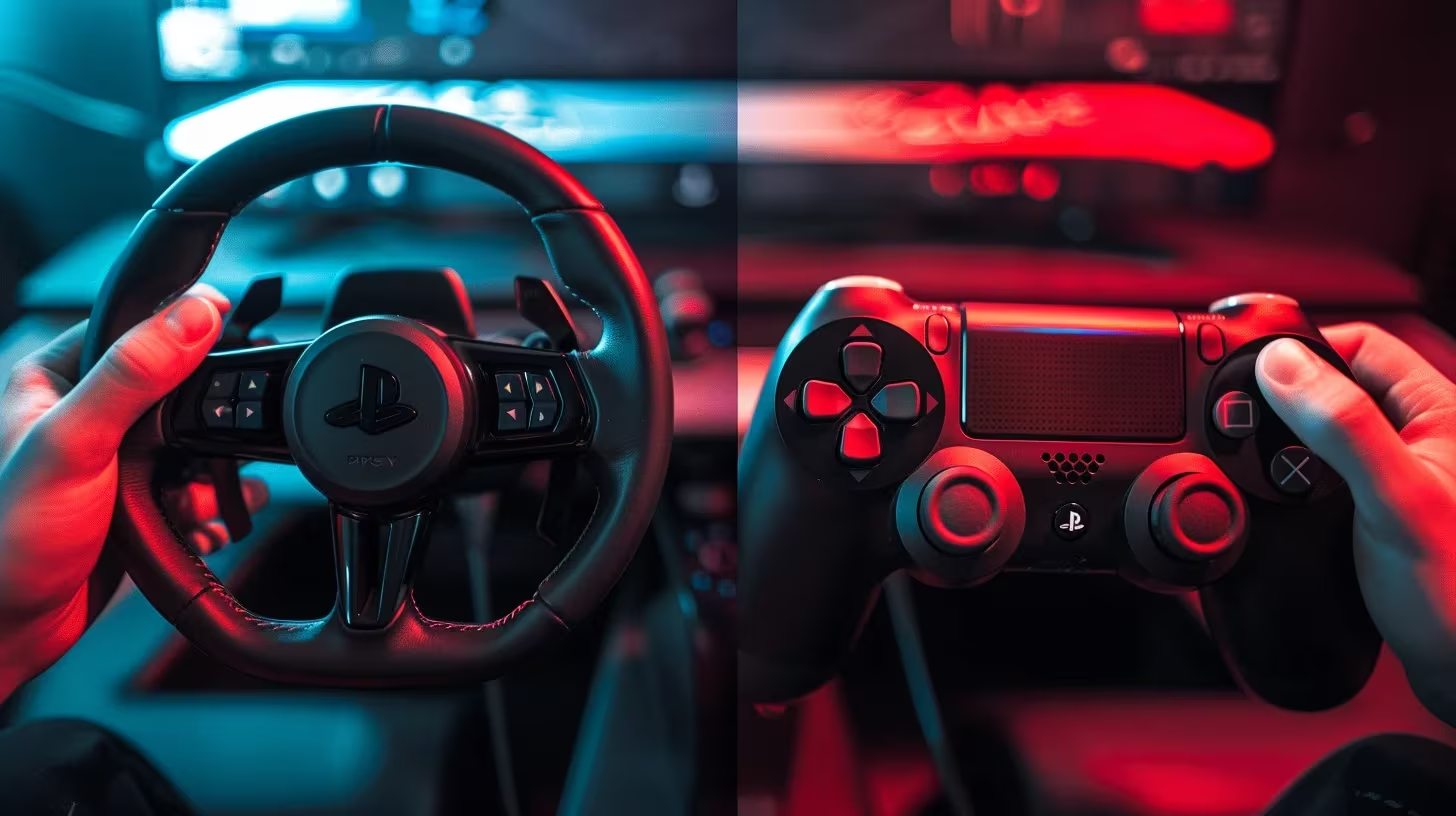
Why Almost Every Serious Sim Racer Makes the Switch
Racing with a controller or with a racing wheel are two completely different worlds. Most sim racers start with a gamepad, but sooner or later the question arises: is a racing wheel worth it? For anyone who takes sim racing seriously, the answer is almost always: yes.
Controller vs. wheel: the fundamental difference
With a controller you have speed and convenience. A thumbstick flies from left to right in an instant; triggers give you immediate full‑throttle or abrupt braking. Many games also provide subtle assists to controller users (like in Gran Turismo 7), making mistakes more forgiving.
A racing wheel brings you much closer to the real‑life racing experience. You get a full steering rotation (usually 900°), separate pedals and – crucially – force feedback (FFB). You feel what the car is doing: when the tyres lose grip, when you run over curbs, or when a spin is about to happen. That tactile information is missing on a controller.
The benefits: why a wheel elevates your game
Precision and control
Because of the larger input range you can steer and modulate much more finely. A small turn equals a small steering angle. With a controller, a tiny thumb movement often translates into a relatively large input. With a wheel you generally drive faster and more consistently.
Force feedback and realism
Every bump, every slip, every locking tyre is fed back through the wheel. You develop a better feel for vehicle control and learn to anticipate. It’s no coincidence that professional drivers use simulators with wheels to learn circuits.
Immersion and fun
With wheel and pedals you feel like you’re in a cockpit. Shifting with paddles, modulating with your foot, applying counter‑steer – it feels authentic and intense.
Higher skill ceiling
In serious simulators (iRacing, Assetto Corsa Competizione) wheel‑users have a long‑term advantage. A wheel simply expands what’s possible.
The downsides: staying realistic
Learning curve
Almost everyone is slower at first with a wheel. You have to get used to pedal operation, larger steering movements and FFB. Give yourself time; every session gets better.
Cost
A controller costs a few tens of euros; a decent wheel starts around €200–€300. Top models are €500+; add better pedals, a shifter or a cockpit and the price climbs quickly.
Space and setup
A wheel needs mounting to a desk or wheel stand and time to assemble. For a quick casual race a gamepad is more convenient.
Compatibility
PlayStation wheels don’t work on Xbox and vice‑versa. On PC almost everything works, but you need to keep an eye on drivers and firmware.
Which wheels do we recommend for beginners?
Below are a few popular choices, listed from low to high price and performance. We link to our product pages for details, prices and specs.
Logitech G29/G920 (≈ €250–€300)
The classic. Dual‑motor, gear‑driven, 900° rotation and metal pedals with a clutch. It makes a bit of gear whine, but offers a lot of value for the money.
Thrustmaster T150/TMX (≈ €200–€250)
The cheapest serious FFB wheel. Hybrid belt/gear, 900° rotation. The included pedals are basic but upgradeable later. Perfect as an entry point.
Thrustmaster T300 RS GT (≈ €350–€400)
Mid‑range with belt drive and a brushless motor for smoother FFB. Removable wheel rim, around 4 Nm torque. Ideal step toward high‑end.
Fanatec CSL DD 5 Nm (starting at ≈ €350)
Entry‑level direct drive: very direct and detailed, no belts or gears. Premium feel, modular ecosystem.
Fanatec GT DD Pro (≈ €700–€850)
For those who are sure sim racing is a long‑term commitment. Direct drive with 5–8 Nm (with boost). Extremely detailed FFB and official PlayStation support.
Competitive racing: a wheel is virtually mandatory
In online leagues and eSports (F1 Esports, Le Mans Virtual, iRacing) virtually everyone uses a wheel. The exception is Forza, which is heavily tuned for controllers. For most simulations the rule of thumb is: with a controller you’re at a disadvantage at the highest levels.
“The controller is easy to get into but hard to master; the wheel is hard to get into but gets easier and more rewarding as you master it.”
Tips for your first races
- Be patient – you’ll be slower at the start. Focus on consistency; speed will follow.
- Calibrate properly – set up wheel and pedals correctly. Look up recommended FFB settings per game.
- Tweak game settings – turn off unnecessary assists; with a wheel you’ll drive more realistically.
- Learn real techniques – left‑foot braking, trail‑braking, counter‑steer on oversteer.
- Join the community – r/simracing, RaceDepartment and GTPlanet are full of tips.
Conclusion: absolutely worth it
A wheel offers unmatched immersion, better vehicle control and usually faster, more consistent lap times. Yes, there’s a learning curve and it costs money and space. But those first laps with force feedback – feeling every corner, rescuing a slip – are so satisfying that most people never want to go back.
Take your sim racing seriously? Then a wheel setup is the logical next step. It opens the door to higher realism and competition. Controllers remain handy for casual play, but for the true sim‑racing experience there’s no substitute.
Based on experiences from the sim‑racing community (including Reddit, GTPlanet), reviews and practical feedback from drivers and leagues.