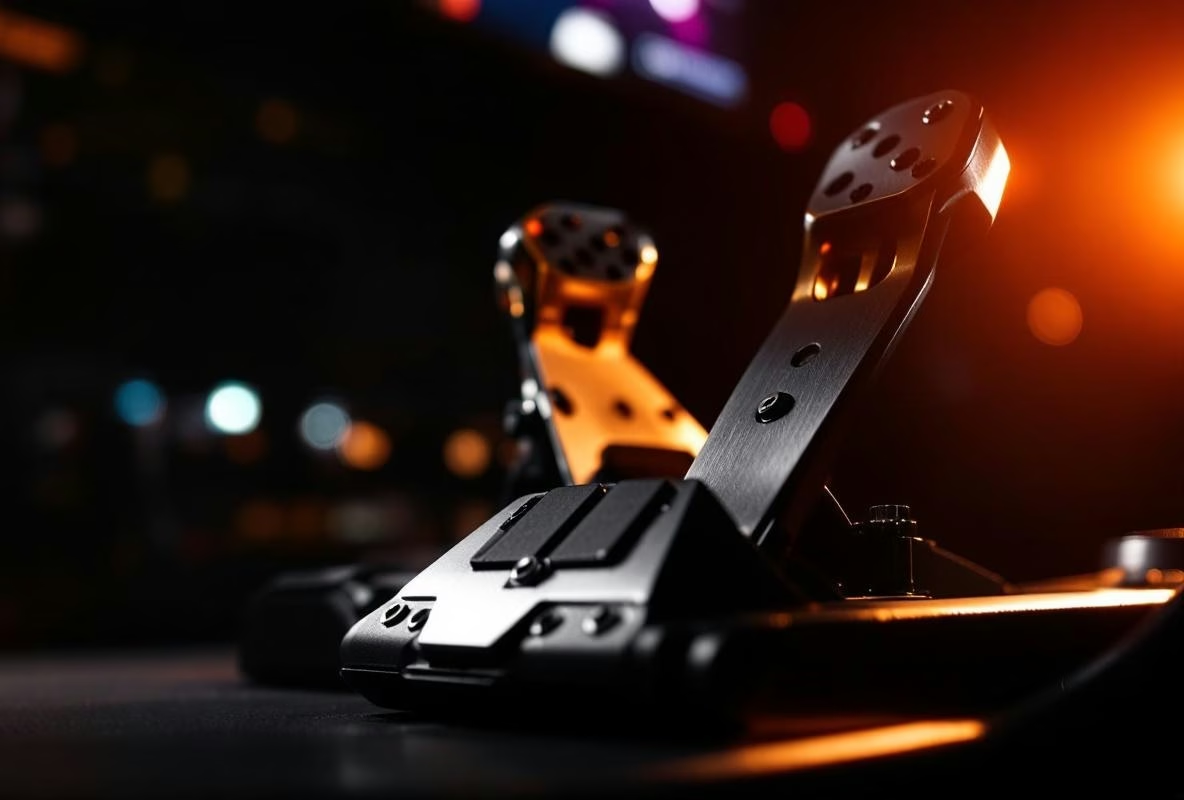
The Sim Racing Pedal Upgrade Path: From Entry-Level to Pro
I made a mistake a few years back. An expensive one. I bought a new wheelbase, a fancy screen, a rig (the whole deal). But I kept using the pedals that came with my old gear. Plastic stuff with a potentiometer. The result? I braked myself straight into the gravel. Constantly. My consistency was a joke, and trail braking felt like guessing the lottery. That’s when it hit me: your pedals are your most important connection to the car. Full stop.
Most people throw cash at a powerful wheelbase first. I get it, the feedback is immediate. But pedals? They determine if you even make the corner. This isn’t a gentle suggestion. If you’re serious about speed and consistency, a pedal upgrade is the single most impactful move you can make. Let’s break down how to do it without lighting your wallet on fire for no reason.
Why your pedals (actually) need an upgrade
Your current pedals are lying to you. Potentiometer pedals (those standard plastic ones) only measure how far you push the pedal. Not how hard. In a real car, you push against hydraulic pressure. In the sim, you need to feel force. Load cell pedals do that. They measure force, not distance. That’s what makes the difference.
Suddenly you’re braking by feel, not by position. You can consistently hit 80% brake pressure, instead of trying to push the pedal exactly 1.5 inches. It’s a fundamentally different system.
And no, you don’t need to drop a grand right away. There’s a path.
Stage 1: out of the plastic pool
You’re coming from the pedals that bundled with your Logitech or Thrustmaster wheel. Or maybe the base Fanatec CSL Pedals without the load cell kit. Time to grow up.
The Budget King: Fanatec CSL Pedals V2 with Load Cell Kit
This is the starting point for most. For around $330, you get a three-pedal set where the brake uses a proper load cell. It’s a massive leap from what you know. The construction is sturdier, you can adjust the brake spring, and you learn what pressure feel is for the first time.
It’s not perfect. The load cell tops out at 90kg, and the throttle/clutch still use pots. But it’s a world of difference from what you had. For the price? Hard to beat.
The Competitor: Thrustmaster T-LCM
The other major player in this bracket. Around $200-$215. They do the same thing: load cell brake, adjustable spring, way better than any other Thrustmaster pedal. Choosing between these and the Fanatec often comes down to which ecosystem you’re already in. Both are solid choices to escape the plastic world.
Common myth: you need a metal rig for load cell pedals. Not necessarily. A sturdy wheel stand, like the Next Level Racing Wheel Stand 2.0, can often handle 90kg of brake force. But if you’re really stomping, you’ll want something more robust eventually.
Stage 2: the middleweight
You’ve tasted load cell. You get it now. But you want more. More feel, more adjustability, more professionalism. Welcome to the mid-tier, where the real choices get difficult.
The Value Champion: VRS DirectForce Pro Pedals
Around $849-$898. This is where opinions split, but here’s mine: for pure price/performance, the VRS pedals are almost untouchable. They use a direct-drive motor for the brake (yes, like a high-end wheelbase) instead of an elastomer stack. The result? A linear, consistent, and adjustable feel that you won’t want to give up. You can fine-tune the brake curve in software. The construction is a metal beast. These are pedals you could use for the rest of your sim racing career.
The downside? Brake and throttle only. The clutch is a separate, expensive module.
The All-Rounder: Simagic P1000
The P1000s (starting at ~$489-$579 for a 2-pedal set) are the ultimate ‘Lego set’. Hydraulic feel? Buy the hydraulic insert accessory. Haptic feedback? There’s a module for that. Clutch, different pedal faces, it can all be added. They’re endlessly modular and the quality is top-notch. If you’re a tinkerer who loves to dial in your perfect setup, these are your pedals. They compete directly with VRS, but with a different philosophy: modularity over pure brute-force simplicity.
The Old Guard: Heusinkveld Sprint
For a long time, the undisputed king of the mid-tier. Still fantastic pedals (~$675-$699 for 3-pedal set). They use an elastomer stack for the brake, which gives a more progressive, snappy feel than the linear VRS. Some people swear by it. They’re robust, reliable, and have a stellar reputation. But with the rise of VRS and Simagic, the competition is fierce now. It’s a matter of taste.
This stage is about personal preference. VRS for pure linear feel and value. P1000 for endless tinkering. Sprint for a proven, progressive feel. You can’t really go wrong here.
Stage 3: the holy grail
You have money to burn. You want the absolute best. The feel of a real race car. This is the world of hydraulic pedals.
The Hydraulic Benchmark: Simucube ActivePedal
Let’s not beat around the bush. The ActivePedal ($1,395 per pedal) is in a different category entirely. It’s not a passive hydraulic system. It’s an active, force-feedback pedal. The wheelbase sends signals to your pedal. You feel ABS pulsing, brake slip, even the difference between brake discs. Wild.
But it costs more than most people’s entire setups. It’s for the fanatic who accepts zero compromises.
Pure Hydraulics: Heusinkveld Ultimate+ / Asetek Invicta
These pedals (Heusinkveld Ultimate+, both well over $1,000) use real hydraulic cylinders, just like a real car. The feel is smooth, natural, and very consistent. The Ultimate+ is the grown-up version of the Sprint, with every adjustment imaginable. The Asetek Invictas are known for their rock-solid construction and unique ‘three-in-one’ pedal block. Both are top-tier.
The difference from the ActivePedal? These are passive. They give amazing, consistent feel, but they don’t simulate extra effects. They’re just fantastic hydraulic pedals.
Is it worth it? If you want to find that last 0.3 seconds per lap and money is no object, yes. For 99% of sim racers? The mid-tier pedals are more than enough. Seriously.
The big question: do you skip a stage?
Here’s my hot take: you can absolutely jump from entry-level pedals straight to the mid-tier (VRS/P1000/Sprint). You skip the ‘budget’ load cell stage. Why? Because those mid-tier pedals are so good, they’re an endgame. You buy them once. You’re done. It saves you an intermediate step and money in the long run.
But. And this is a big but. You need a solid rig first. Putting $600 pedals on a wobbly desk stand is a waste. Get a solid foundation. Then get the fancy pedals.
What you need to know before buying
- Rig First: I can’t say it enough. No high-end pedals without a solid, metal cockpit. Period.
- Clutch is Optional: For pure racing (GT3, Formula), you don’t use the clutch. Save money by starting with a 2-pedal set.
- Hydraulic ≠ Better: A well-tuned load cell brake can feel better than a poorly tuned hydraulic one. It’s about the feel and consistency, not the marketing term.
- Try Them: Go to a sim racing event, ask in communities. Feel is personal.
My path? I went from plastic pedals to Heusinkveld Sprints. Used them for years, zero regrets. Today, I’d probably lean towards VRS or P1000. The choice is huge. But the lesson is the same: upgrade your pedals. It’s the fastest route to better lap times. And fewer gravel traps.