I once set my brake pedal so far forward I nearly fell out of my seat trying to reach it. True story. I thought it would ‘add realism’. What it added was a sore calf and a disappointing qualifying time. Here’s the thing: everyone talks about torque and FFB, but setting up your pedals? That’s where you actually find time. And avoid pain.
Let’s fix that.
The Seat First. Always.
You don’t start with the pedals. That’s your first mistake. You start with your seat. Why? Because your body is one linked system. The angle of your hips dictates everything. If your seat is too upright, you can never put enough pressure on the brake. Too reclined? Your ankles will stage a protest.
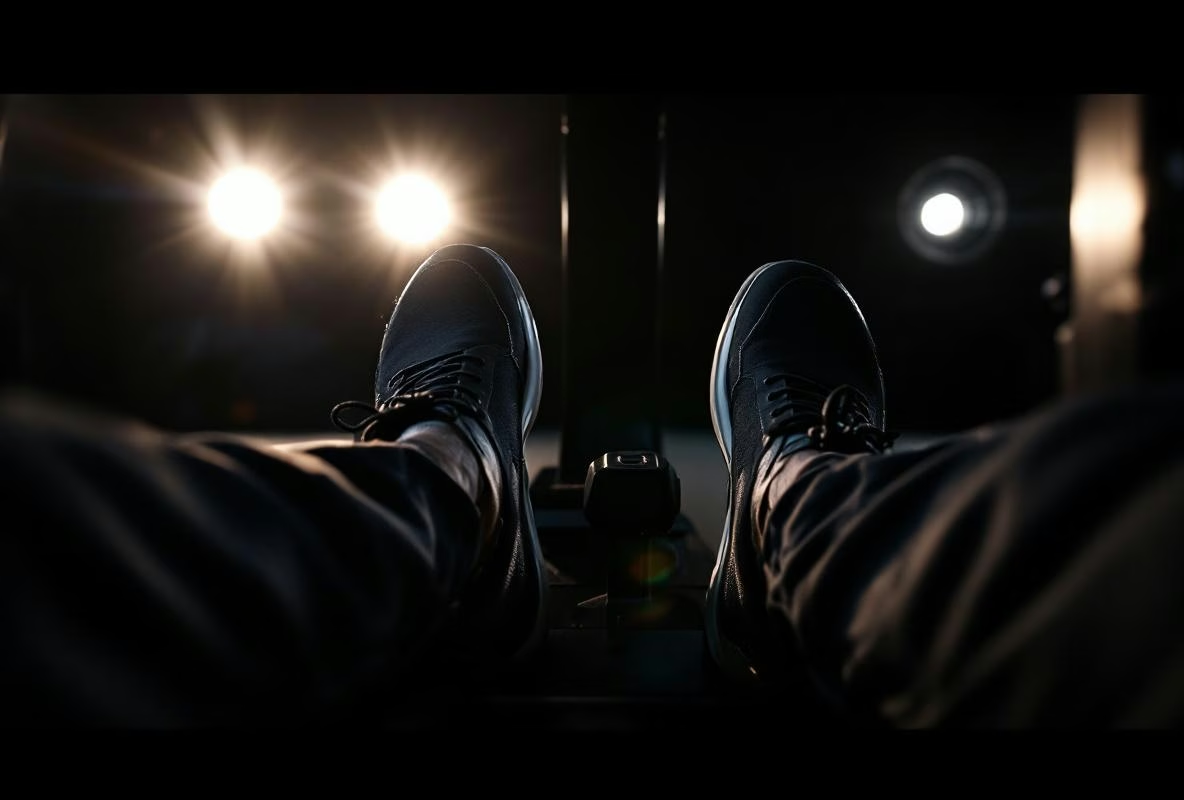
Set your seat so your hips are roughly level with your knees, or just a bit higher. Your feet should be able to flop forward comfortably without your toes pointing straight down. Try it. Sit down and let your feet dangle forward. Where do they land? That’s roughly where your pedals should be.
Simple. But nobody does it.
The Big Three: Height, Distance, Angle
Okay, now the pedals themselves. Three variables can wreck everything: height, distance (from your body), and angle. Usually you adjust them all at once. That’s confusing. Let’s isolate them.
Distance: Where Your Feet Live
This is the big one. Get in your ideal driving position. Place your heel on the footplate, or where your heel would normally rest. Your knee should have a slight bend, about 120 to 135 degrees. Not straight. Absolutely not straight. And not tucked up into your chest like a startled rabbit either.
The test? Press the throttle all the way. Your knee angle shouldn’t go below 90 degrees. If it does, you’re too close. Slide the pedal set forward. Too far away? You’ll be pointing your toes. Move it back.
Height: The Sit-Stand Paradox
Should your pedals be higher than your butt? Lower? The answer depends on what you’re mimicking.
For a modern Formula 1 or GT-style position (reclined, legs up), you often place the pedal set HIGHER than your seat. This gives you more leverage for braking. For a classic rally or road-car position, lower or level. Most people just plonk them on the floor. That’s fine. But if you have a rig with adjustable pedal plates, experiment. A couple of inches up can completely change the brake feel.
Most importantly, make sure your heel isn’t floating in mid-air. You need a pivot point.
Angle: The Secret Weapon for Consistency
Ah, the pedal angle. The source of endless tinkering. The standard rule: the pedal face should be roughly perpendicular to your natural foot fall. As your foot drops down, the pedal should meet it at a 90-degree angle.
But here’s my controversial take: for the throttle, you often want a slightly shallower angle. A bit flatter. Why? Because you’re making tiny, fine movements for hours. A too-steep throttle angle fatigues your ankle fast.
The brake? Steeper is fine. You’re using your whole leg, not just your ankle. An angle between 15 and 30 degrees (from the floor) is a solid starting point. Many load cell pedals, like the Fanatec Clubsport V3 or Heusinkveld Sprints, are set up this way by default.
Where Do You Put Your Foot? The Heel Dilemma
Heel-and-toe? More like heel-or-toe. Where does your heel rest?
- Heel on the floor: Classic. Good for throttle consistency and for heel-and-toe downshifts. Requires your pedals to be close together.
- Heel in the air (pivoting): Lots of people do this unconsciously. Your heel rests on nothing, your whole leg is the lever. This can feel more powerful for braking, but it’s more fatiguing and less consistent for throttle.
My advice? For beginners: try to plant your heel somewhere. Pick a spot, on the floorplate between gas and brake, or on the brake plate itself, and stay there. It creates a fixed pivot point. An anchor. Consistency comes from repetition, and repetition comes from a fixed reference point.
See your foot sliding and searching during a race? That’s your body saying your anchor point is wrong.
Product Specific: Where Are the Dials?
All the theory is nice, but you need to know where to turn the screws.
- Fanatec Clubsport Pedals V3: The entire pedal plate tilts via four bolts at the back. Loosen, tilt, tighten. Adjust distance by sliding the whole unit on your rig.
- Heusinkveld Sprint/Ultimate: Super adjustable. Individual pedal angles via the front axle. Height via the mounting points on the profiles. This is the playground where you can get lost for hours.
- Thrustmaster T-LCM: Basic angle adjustment via the three different mounting holes on the bottom. More advanced? You need to tilt the whole unit on your rig.
- Logitech Pro Racing Pedals: Fixed angle, but you can adjust pedal stiffness and distance themselves. Focus there.
The trick? Change one thing at a time. Drive a few laps. Feel the difference. Write it down if you have to. ‘Angle 5 degrees steeper, brake more sensitive, throttle heavier.’
The Quick Pre-Drive Checklist
Before you head out of the pits, run through this:
- Are you sitting comfortably? Back, shoulders, arms relaxed?
- With your heel on its rest, can you fully press the throttle without locking your knee straight?
- Can you brake fully without your hip lifting from the seat? (This is key. If not, seat forward or pedals back).
- Does your foot move effortlessly from gas to brake? No unnecessary lift?
- Does it not feel like you’re in a ballet class? Good.
Stop Tweaking. Drive.
Here’s the final piece of advice, and it’s the hardest one: at some point, you have to stop.
You can waste a whole week on millimeter-perfect adjustments. A quarter degree here, a centimeter there. It becomes an obsession. Set a base that feels good, not perfect, good, and then drive with it for at least a week. Your body needs time to adapt. The muscle memory needs to form.
After that, if something is clearly wrong, pain, inconsistency, fatigue, adjust one specific thing. But not before.
The perfect setup doesn’t exist. There’s only the setup that lets you forget you’re in a simulator, and just drive. Start there. Everything else is noise.