Test your knowledge! Before reading on, why not test your circuit knowledge with our Guess the Track Quiz.
Think you can recognize Eau Rouge from a single screenshot? Before you test yourself, let’s explore what makes F1 circuits so unique, and why every corner tells a story.
If you’ve ever white-knuckled your way through Spa’s Eau Rouge in a sim, felt the claustrophobia of Monaco’s barriers inches from your wheel, or wondered why Abu Dhabi looks so different from Monza, you’re not alone. Formula 1 tracks are far more than ribbons of asphalt, they’re carefully engineered theaters of speed where 104-meter elevation drops, 5G corner forces, and 330 km/h straights separate champions from the rest.
Understanding track design doesn’t just make you a better-informed fan, it makes you a faster sim racer. So let’s dive into how these iconic circuits came to be, why some feel so different from others, and what separates a classic from a “Tilkedrome.”
From Hay Bales to Halos: How Tragedy Shaped Modern Circuits
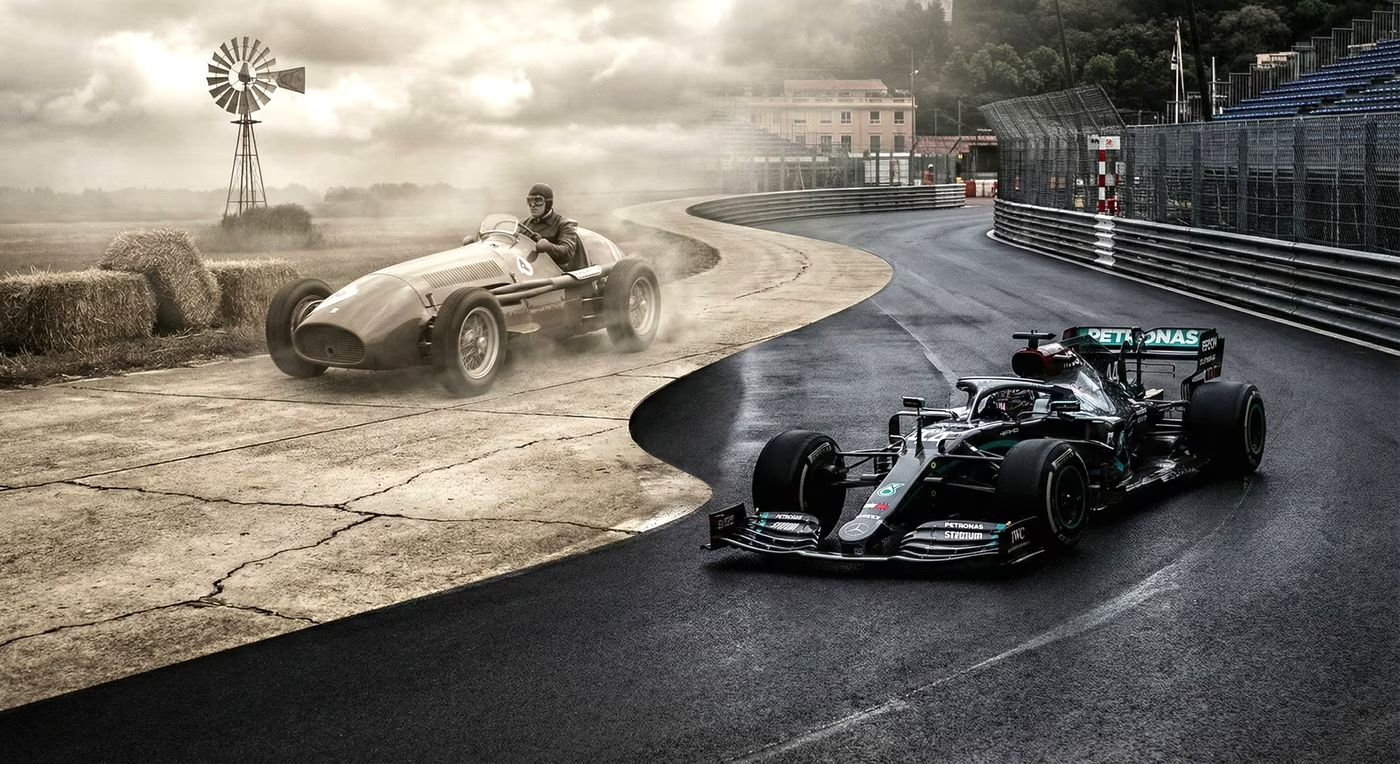
The first F1 World Championship race at Silverstone in 1950 took place on a converted RAF airfield with eight corners, hay bales for barriers, and virtually no safety equipment. Early circuits like Spa-Francorchamps used 14 kilometers of public roads winding past houses, telegraph poles, and ditches. The original Nürburgring Nordschleife stretched an almost incomprehensible 22.8 kilometers with 174 corners, nicknamed “The Green Hell” by Jackie Stewart, where proper safety coverage was physically impossible.
The human cost was staggering. During the 1950s and 1960s, drivers faced roughly a two-in-three chance of dying over a five-year career. Jackie Stewart himself nearly died at Spa in 1966, crashing at 265 km/h into a telegraph pole and spending 20 minutes trapped in his overturned car while fellow drivers borrowed tools from spectators to extract him.
That crash transformed Stewart into F1’s greatest safety crusader. When Niki Lauda’s Ferrari burst into flames at the Nordschleife in 1976, it confirmed what everyone knew: F1 would never race that circuit again.
The deaths of Ayrton Senna and Roland Ratzenberger at Imola in 1994 triggered another revolution. Within weeks, the FIA identified 27 high-risk corners worldwide for modification. Tamburello, where Senna died, became a chicane. From 1994 to 2014, no driver died during an F1 World Championship event, a testament to these reforms.
For sim racers: Next time you clip a barrier and respawn instantly, remember that every modern safety feature, from the halo to TecPro barriers, exists because someone paid the ultimate price on these same corners.
The Engineering Behind Every Apex
Modern circuit design balances competing demands: creating exciting racing, ensuring driver safety, and satisfying FIA regulations. The FIA’s Grade 1 certification requires minimum track widths of 12 meters, maximum straights of 2 kilometers, and sophisticated barrier systems throughout.
Corner geometry dictates the racing spectacle:
- Hairpins like Monaco’s Fairmont (taken at just 48 km/h) create prime overtaking zones because they demand heavy braking
- Sweepers like Monza’s Parabolica (entered at 330 km/h) test aerodynamic efficiency and driver commitment
- Chicanes force rapid directional changes and reset speed
- Compound-radius corners offer multiple viable racing lines, and multiple ways to get it wrong
The key principle that every sim racer should internalize: “Set yourself up in the present to maximize speed later.” This means late-apex lines before long straights, allowing earlier throttle application for maximum exit speed. It’s why getting Raidillon wrong costs you time all the way down the Kemmel Straight.
Elevation changes create what designers call “the third dimension.” At Spa’s Eau Rouge-Raidillon sequence, drivers experience up to 5G of compression as they dip into the valley before climbing a 17% gradient toward a blind crest. Modern F1 cars take this flat-out at over 300 km/h, but in your sim rig, you’ll feel exactly why lifting at the wrong moment is so costly.
Spa-Francorchamps: The Driver’s Favorite
No circuit better captures the soul of motorsport than Spa. Born in 1921 when newspaper owner Jules de Thier conceived a triangular circuit connecting three Ardennes towns, the original 14.9-kilometer layout used ordinary public roads.
Here’s something to impress your racing buddies: Most people get Eau Rouge wrong. “Eau Rouge” refers only to the small left-hand kink at the valley bottom, named after the iron-rich stream (meaning “red water”) flowing beneath. Raidillon, French for “steep road”, is the dramatic uphill sweep that follows. So technically, when commentators say “flat through Eau Rouge,” they should say “flat through Eau Rouge and Raidillon.”
The modern 7-kilometer layout combines:
- Raidillon’s commitment-testing blind climb
- The 270 km/h double-apex Pouhon
- The flat-out 300 km/h Blanchimont through forest
- The treacherous microclimate that can have rain on one section while another stays dry
Michael Schumacher made his F1 debut here in 1991, qualified an astonishing seventh, and won six races at Spa, more than any other driver. In your sim, you’ll quickly understand why drivers consistently rate it their favorite: it rewards bravery, punishes hesitation, and feels alive in a way few tracks do.
Monaco: Where Precision Beats Power
Monaco represents something entirely different: the ultimate test of precision over pure speed. The circuit has remained substantially unchanged since 1929, snaking past the Casino de Monte-Carlo, plunging through the tunnel at 260 km/h before emerging into blinding Mediterranean sunlight.
The Fairmont Hairpin is the slowest corner in F1 at 48 km/h, where modern cars barely fit side by side. And that’s the problem, overtaking at Monaco has become virtually impossible. The 2023 race saw zero on-track passes. Cars are now over two meters wide on streets originally designed for 1920s machinery, with some sections just seven meters across.
Yet Monaco endures because victory there carries unique prestige. Ayrton Senna won six times, including the 1992 masterclass where he held off Nigel Mansell’s faster Williams for four laps with millimeter-perfect defensive driving.
Sim tip: Monaco is where you learn that smooth is fast. Attack too hard, clip a barrier, and you’re done. The fastest drivers here are the ones who can put in 78 identical laps with zero drama. It’s exhausting, but incredibly satisfying when you nail it.
The Tilke Era: Love It or Hate It
Since the mid-1990s, German engineer Hermann Tilke has designed virtually every new F1 circuit: Sepang, Bahrain, Shanghai, Istanbul Park, Yas Marina, COTA, and more. His philosophy emphasizes elevation changes and long straights followed by heavy braking zones to create overtaking opportunities.
The criticism? Three-time champion Jackie Stewart called his designs “largely carbon copies of each other.” The term “Tilkedrome” emerged to describe perceived homogenization, the “hairpin-straight-hairpin” formula repeated across continents.
But defenders point to genuine achievements. Istanbul Park’s Turn 8, a four-apex left-hander taken nearly flat-out, is widely considered one of the best corners ever designed. COTA’s dramatic 40-meter climb to Turn 1 delivers spectacular racing. And the safety record speaks for itself.
Abu Dhabi’s Yas Marina, with its $1 billion price tag and LED-lit hotel straddling the track, represents peak Tilke: visually stunning, technically proficient, but lacking the organic character of Spa or Silverstone. The 2021 modifications removed four slow corners and added a sweeping banked turn, proof that even modern circuits keep evolving.
What This Means for Your Sim Racing
Understanding circuit characteristics transforms your approach:
| Track Type | Setup Philosophy | Key Challenge |
|---|---|---|
| Power tracks (Monza, Baku) | Minimal rear wing, low drag | Top speed vs. stability |
| High-downforce (Monaco, Hungary) | Maximum wing angles | Mechanical grip in slow corners |
| Mixed (Spa, Silverstone) | Balanced compromise | Sector-by-sector adaptation |
Monza remains the temple of speed, 80% of the lap at full throttle, where every tenth lost to drag costs you down those endless straights. Monaco demands maximum downforce because you’re never going fast enough for it to matter aerodynamically.
At Spa, the microclimate means you might encounter rain in one sector while another stays dry. In your sim, this translates to understanding why setups feel different corner to corner, and why mastering Pouhon requires different skills than nailing the Bus Stop chicane.
Think You Know Your Tracks?
Every circuit tells a story. Tamburello’s chicane exists because Senna died there. Monza’s abandoned banking, still visible in satellite imagery, was closed after tragedy in 1961. Raidillon was built in 1939 to bypass a slow customs checkpoint.
The science of track design matters, but so does the soul, the accumulated history of triumph, tragedy, and the eternal human desire to go faster than anyone has gone before.
Ready to test your knowledge? We’ve built a game where you have to identify famous circuits from a single image. Some are obvious, Monaco’s harbor backdrop is hard to miss. Others will challenge even seasoned sim racers.
👉 Play “Guess the Track” now and find out if you really know your circuits as well as you think.
Got a perfect score? Share it on social media and challenge your racing friends. And if you’re looking to upgrade your sim rig setup, check out our equipment guides to make those virtual laps feel even more real.