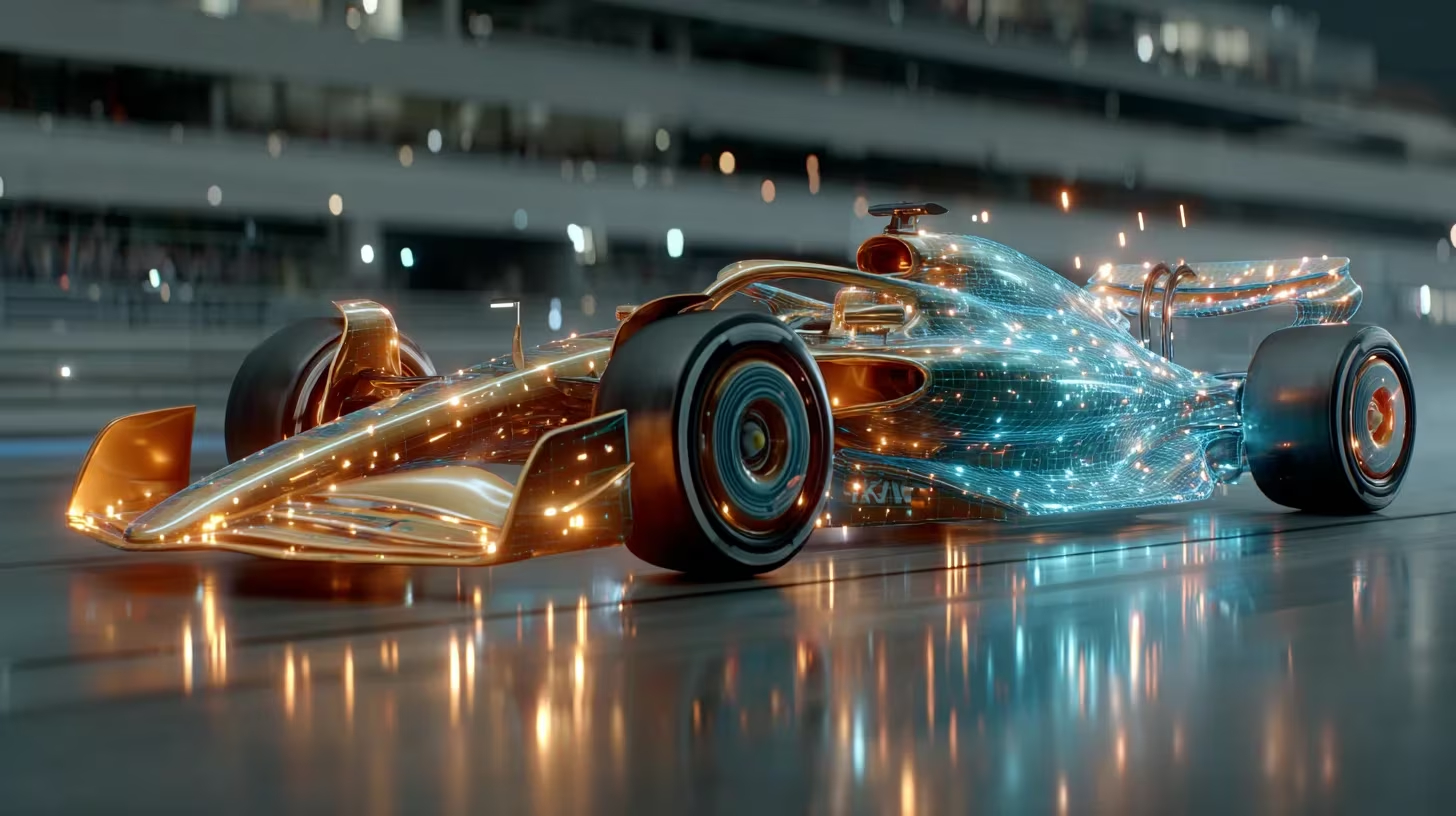
Formula 1 cars of 2025 are no longer simple race cars but rolling data centers. More than three hundred sensors, kilometers of wiring and a standardized McLaren ECU feed an uninterrupted data stream every lap. During a grand prix weekend, teams collect over a terabyte of raw data: tire temperatures, brake pressure, energy flows and even the driver’s biometrics.
With this interactive guide you’ll discover step by step how the telemetry stream works: from the sensors on the car, via the WiMax mesh at the pit wall to the factory within milliseconds. View the live simulation and switch between European and fly-away races to get a realistic picture of data volume, speed and processing according to the current telemetry regulations.
Sensors: the car as data factory
Top teams mount 250 to 300 sensors on the car. They measure everything: tire temperatures on all four wheels, brake pressure, engine RPM, fuel consumption, suspension, steering angle, ERS deploy and the G-forces the driver is exposed to. The sampling rate runs up to 1,000 times per second on critical channels.
The live simulation below shows how broad that sensor stream is: values jump constantly, as if you're watching a qualifying run. The canvas visualization under the grid makes visible how quickly new data points follow each other.
Onboard network and the McLaren ECU
All sensors communicate via a robust CAN bus that runs through the entire car – the same automotive standard you find in passenger cars. That bus feeds the standardized McLaren Applied SECU, the central brain that handles both engine control and data logging. In the visualization you see how subsystems like brakes, suspension and aerodynamics are connected to that backbone.
sensors
& ERS
& brakes
inputs
ECU
The CAN bus forms the backbone: all sensors talk to the McLaren ECU.
- CAN bus: Automotive standard with deterministic timing so signals never collide.
- Standardized ECU: Since 2008, every team uses the same McLaren Applied SECU, allowing the FIA to enforce complete logging.
- Onboard buffering: Solid-state storage captures every run so nothing is lost during radio dropouts.
- Telemetry gateway: The ECU compresses and encodes the data stream for transmission via the WiMaX transmitter.
WiMaX mesh: from car to pit wall in milliseconds
Formula 1 Management manages its own WiMaX 802.16 network around each circuit. Access points are positioned around the track forming an overlapping mesh. As the car passes at over 300 km/h, the ECU seamlessly switches between access points so the stream never stops.
- Frequency band: Around 3.5 GHz in a licensed band (depending on local spectrum rules).
- Bandwidth: Space for 1,000 to 2,000 channels per car at 100-1,000 Hz.
- Security: End-to-end encryption; teams cannot eavesdrop on competitors.
- Mobility tweaks: Adaptations to WiMax 802.16 for 300+ km/h and heavy Doppler effects.
- Failover: Mesh topology automatically routes around a defective access point.
When asked which wireless technology Formula 1 uses, a former engineer explains it's a proprietary WiMax 802.16 implementation. McLaren Applied manages the service for all teams, based on technology from former startup Picochip. The system processes an astounding amount of telemetry and onboard video and runs on 3.5 GHz spectrum that's virtually available worldwide. For each circuit, temporary base stations are built so the mesh provides complete coverage.
Why WiMaX? The protocol is designed for high speed, large distances and fast handovers – exactly what you need when 20 cars are simultaneously going 300 km/h.
From pit wall to factory
In the garage, an ATLAS telemetry server functions as distribution hub. Engineers at the pit wall, strategists in the command center and analysts in the factory see the same live data. The delay is determined by the fiber or satellite route available from the circuit.
Use the buttons to see the difference between a European race and an overseas fly-away. Notice how the international connection increases total latency.
Data analysis: from raw numbers to decisions
A telemetry stream by itself doesn't win races. Teams use machine learning, digital twins and fast cloud clusters to calculate every lap. Strategists compare real-time data with thousands of scenario simulations running in the factory.
- Predictive models: predict tire degradation, fuel consumption and pit stop windows.
- Digital twins: virtual replica of the car fed live for what-if analyses.
- Automatic alerts: instant warnings as soon as temperatures or pressure fall outside safe margins.
- Rule enforcement: the FIA receives a parallel feed for direct compliance checks.
- Broadcast augmentation: the same datasets feed television graphics and F1 Insights.
The smart advantage
The F1 car isn't just fast; it's above all smart. Sensors, WiMax, fiber and analytics work like a nervous system that learns from the previous lap every lap. Those who interpret the data faster find grip loss earlier, discover economical engine modes and plan better-timed pit stops.
This creates a feedback loop that gets shorter and shorter. The car sends data to the factory, the factory calculates scenarios, and within seconds the race engineer gets advice back. In 2025, it's not the car with the most horsepower that wins, but the team that uses the data stream most effectively.
What does this mean for sim racers?
Telemetry in Formula 1 shows how valuable data is to become faster and more consistent. Sim racers can apply the same mindset: log your laps, compare inputs and look for trends in tire temperature or brake pressure. The better you understand what’s happening under your virtual car, the easier it becomes to approach the same precision as the professionals.