Oscar Piastri may be one of the fastest rising stars in Formula 1, but at home he’s just as serious about sim racing as his real race weekends. The Australian McLaren driver has spent countless hours in iRacing, regularly joining public lobbies and impressing fellow players with his smooth, competitive driving style. In this deep dive we examine the hardware and software of Piastri’s personal setup and show how you can apply the same principles.
Hub: Browse all F1 driver rigs in the cluster: Complete F1 Driver Sim Racing Setups (2025).
From Fanatec to VRS: Piastri’s evolution
Not every F1 driver starts with top-tier equipment. During the ARG eSports Cup in 2020, Piastri was still running a Fanatec setup: a ClubSport Racing Wheel F1 on a ClubSport Wheelbase v2.5, combined with Fanatec ClubSport V3 pedals. Even after reaching F1, he initially still used those V3 pedals. This proves you don’t necessarily need to spend thousands to train seriously – sometimes the journey begins with a wheel clamped to a desk.
But as his sim racing involvement grew, Piastri upgraded. By 2025 he’s running a full VRS DirectForce Pro setup, a significant step forward in fidelity and force feedback. Reddit users who spotted his rig on streams confirmed: “That’s a VRS setup” – referring to the complete package of wheelbase, wheel and pedals.
Cockpit: Turnkey precision
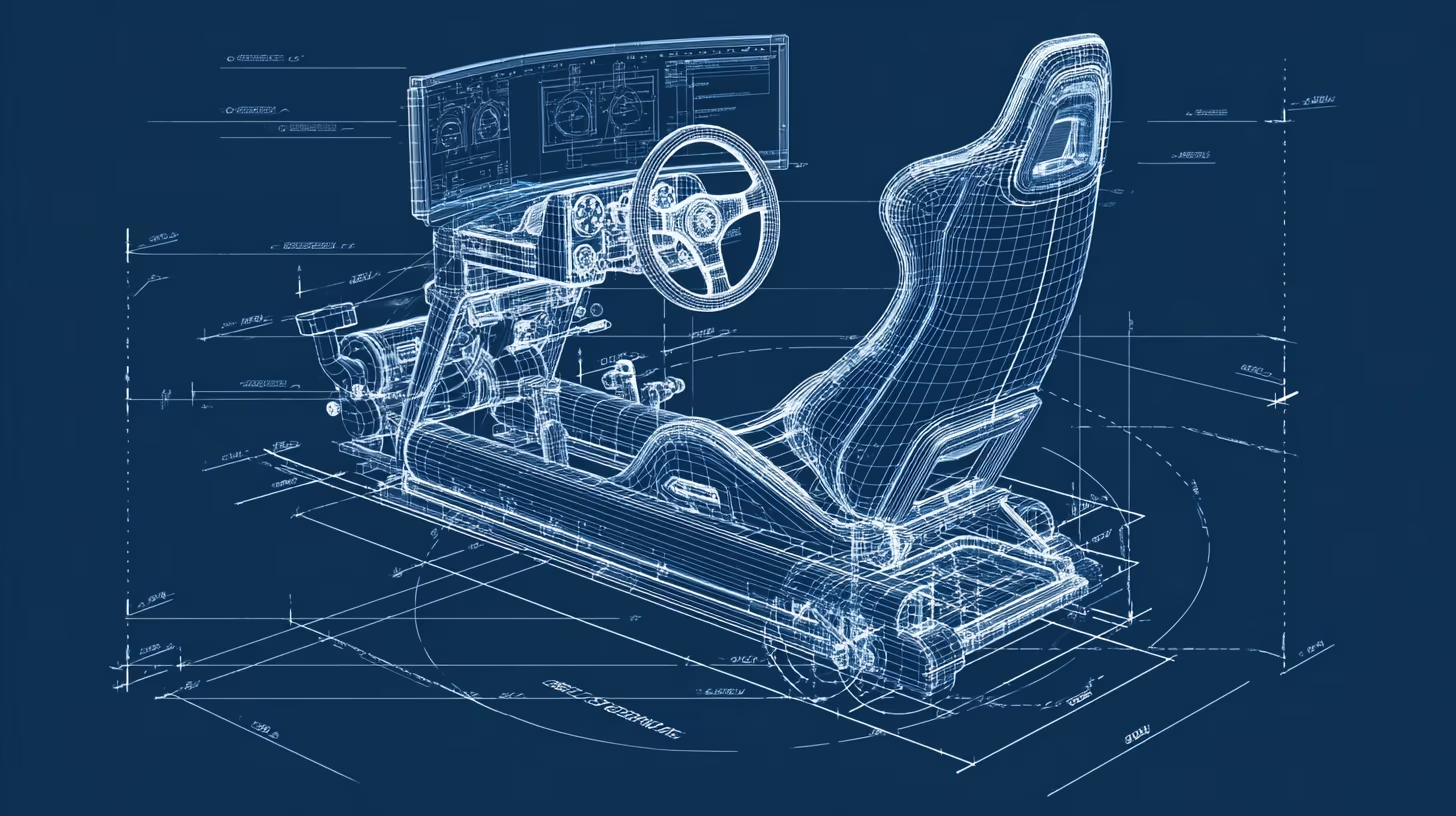
The foundation of Piastri’s simulator is a pre-built Apex Racing Simulators VRS GT chassis. This turnkey rig was delivered as a complete package including:
- GT-style aluminum frame with racing bucket seat
- Integrated monitor stand
- 49-inch super ultrawide monitor
- All necessary mounting brackets for VRS hardware
The total package had an MSRP around £10,000, offering a premium but plug-and-play solution. The rigid aluminum chassis is essential: without a stable base you won’t feel the nuances in force feedback.
Alternatives for your setup:
- The Sim-Lab P1-X offers the same rigidity in a modular 8020 profile you configure yourself
- For a complete F1 experience choose the Playseat F1 Ultimate with integrated seat
- The Sim-Lab GT1 Evo is a compact alternative for those with less space
Wheelbase: VRS DirectForce Pro
The heart of Piastri’s rig is the VRS DirectForce Pro direct-drive wheelbase. This is an industrial servo with approximately 20 Nm of torque – enough to feel every nuance of the track, from kerbs to understeer.
The VRS base distinguishes itself through:
- High torque at a sharp price (~€800, where comparable bases often cost €1,000+)
- Exceptional encoder resolution for millimeter-precise steering behavior
- Direct mounting compatibility with VRS wheels and pedals
Piastri’s choice of VRS over more expensive brands demonstrates you don’t need to spend €2,000+ for factory-level force feedback.
Comparable options:
- The Simucube 2 Pro (25 Nm) is the go-to for many pro sim racers and offers TrueDrive profiles
- The Fanatec Podium DD2 combines 25 Nm with the extensive Fanatec ecosystem
- Budget option: the Fanatec CSL DD 5Nm for beginners who can upgrade later
Wheel: VRS Formula Wheel
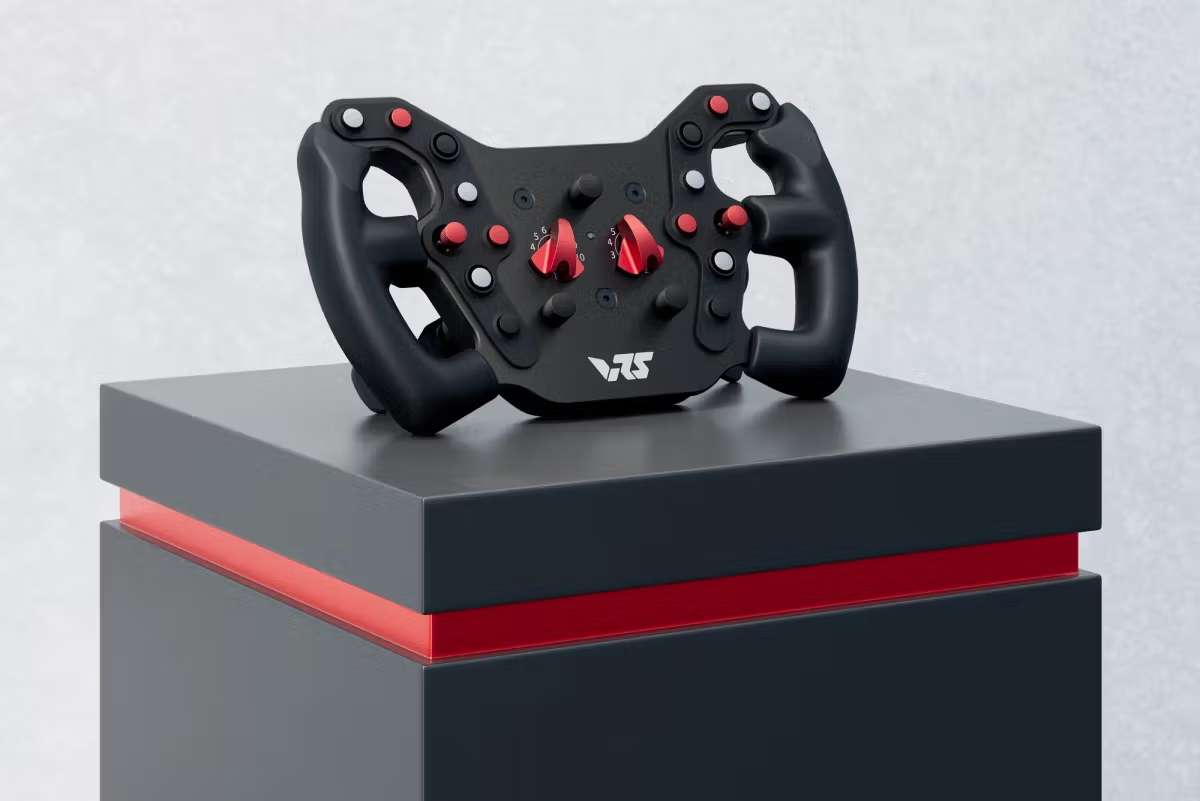
As his wheel, Piastri uses the VRS DirectForce Pro Formula Wheel – a professional formula wheel featuring:
- F1-style shape with compact diameter
- Dual-clutch paddles for race starts
- Multiple buttons and encoders for brake bias, torque maps and radio
- Carbon-look body
The button layout mimics a modern F1 wheel, so the muscle memory he builds in the sim directly translates to his real McLaren MCL60.
Alternatives:
- The Fanatec ClubSport Formula V2.5 offers comparable functionality within the Fanatec ecosystem
- For ultimate flexibility choose the Precision Sim Engineering LM-X
- The Fanatec CSL P1 V2 is a budget-friendly entry point
Pedals: Load-cell brake feel
Brake control is where Piastri makes the difference. He runs the VRS DirectForce Pro Pedals, featuring:
- Load-cell brake up to ~140 kg of force
- Frictionless throttle design for consistent gas input
- Fully adjustable pedal position and resistance
- Price around €600 – significantly less than comparable hydraulic sets
Load-cell technology measures pressure instead of pedal travel. This trains you to consistently apply the same brake force, exactly like in a real F1 car where brake feel is crucial.
Comparable pedals:
- The Heusinkveld Sim Pedals Ultimate+ is the gold standard for load-cell pedals
- The Fanatec ClubSport V3 – Piastri’s old choice – remains excellent for the price
- For active feedback look at the Simucube ActivePedal
- Entry option: the Thrustmaster T-LCM offers load-cell for a fraction of the price
Display: 49-inch ultrawide immersion
Instead of triple monitors, Piastri opts for a single 49-inch super ultrawide curved monitor. This format offers:
- ~180 degree field of view without bezels between screens
- Simpler setup and calibration
- Less GPU load than three separate displays
- Better compatibility with some sim titles
The curve of the monitor wraps around his peripheral vision, keeping mirrors and apex points visible without turning his head.
Monitor options:
- The Samsung Odyssey Neo G9 is the ultimate 49-inch choice with Mini LED and 240 Hz
- The Samsung Odyssey G9 offers the same format at a lower price
- For triple setup: three Samsung Odyssey G7 27” displays
Software: iRacing dominance
Piastri’s primary platform is iRacing – the online racing service known for laser-scanned circuits and realistic physics. His statistics speak for themselves:
- iRating around 5600 – exceptionally high for someone who isn’t a full-time sim racer
- Regular participation in public and competitive lobbies
- Focus on open-wheel formulas (F4, F3 in iRacing) and occasional GT driving
An iRating of 5600+ places Piastri in the absolute top tier of iRacing participants. Community members note he could probably climb even higher if he invested more time – ratings of 8000+ require hundreds of hours of grinding.
Why iRacing works for F1 drivers
Piastri has explained that “the simulator is the only way we can really practice” for certain circuits. The laser-scanned tracks in iRacing closely match the real layouts, including subtle elevation changes and kerb positions. During his F2 period he used the sim to prepare for Monaco, though he noted: “you don’t have quite the same fear of crashing in the sim” – an honest acknowledgment of the limitations.
Other platforms: While iRacing is his main platform, Piastri occasionally appears in the official EA Sports F1 games for promotional events and McLaren Shadow streams. However, he has described the F1 game as “pure arcade” compared to hardcore simulators.
Online presence: Low-profile but legendary
Unlike teammate Lando Norris, who regularly streams on Twitch, Piastri keeps his sim racing activities relatively private. Yet he’s become a legend in iRacing circles:
- Shows up unannounced in public races
- Drives hard but fair, earning him respect
- Responds modestly when fans recognize him in lobbies
- Even wins competitive events: during the ARG eSports Cup 2020 he took a dominant victory at Barcelona in the Dallara F3
His humility in lobbies – despite his F1 status – makes him beloved by the sim racing community.
Lessons from Piastri’s setup
Piastri’s rig offers valuable insights for any sim racer:
1. Start where you can, upgrade when needed
Piastri started with mid-range Fanatec gear and only upgraded as his involvement grew. You don’t need to spend €10,000 immediately.
2. Invest in brake feel
Load-cell pedals are the biggest upgrade for consistency. The Fanatec ClubSport V3 that Piastri used for years is still excellent.
3. Direct drive offers precision
The jump from belt-driven to direct-drive (like VRS or Simucube 2 Pro) gives you earlier feedback about grip and slip.
4. One good monitor > three mediocre ones
A 49-inch ultrawide like the Samsung Odyssey Neo G9 can be better than three budget screens.
5. Choose the right platform
iRacing’s laser-scanned circuits and competitive ladder make it ideal for serious training – exactly why F1 drivers prefer it.
Budget scenarios inspired by Piastri
Pro level (Piastri’s exact approach)
- Turnkey cockpit or Sim-Lab P1-X
- Simucube 2 Pro wheelbase
- Precision Sim Engineering LM-X or Fanatec ClubSport Formula V2.5
- Heusinkveld Sim Pedals Ultimate+
- Samsung Odyssey Neo G9 49-inch ultrawide
High-end enthusiast
- Sim-Lab GT1 Evo
- Fanatec ClubSport DD Wheelbase 15Nm
- Fanatec ClubSport Formula V2.5
- Fanatec ClubSport V3
- Samsung Odyssey G9
Serious starter
Conclusion
Oscar Piastri proves that sim racing isn’t just a hobby for F1 drivers – it’s a serious training tool. His VRS DirectForce Pro setup combines industrial quality with a price point that, while premium, isn’t astronomical compared to the competition. From his humble Fanatec beginnings to his current direct-drive rig, his evolution shows that upgrading can be gradual.
The most important thing isn’t the price of your equipment, but how you use it. With his 5600+ iRating, Piastri proves that talent and dedication matter more than the most expensive gear. Start with what you have, train consistently, and who knows – you might soon be racing against an F1 driver in the same iRacing lobby.
Happy sim racing!