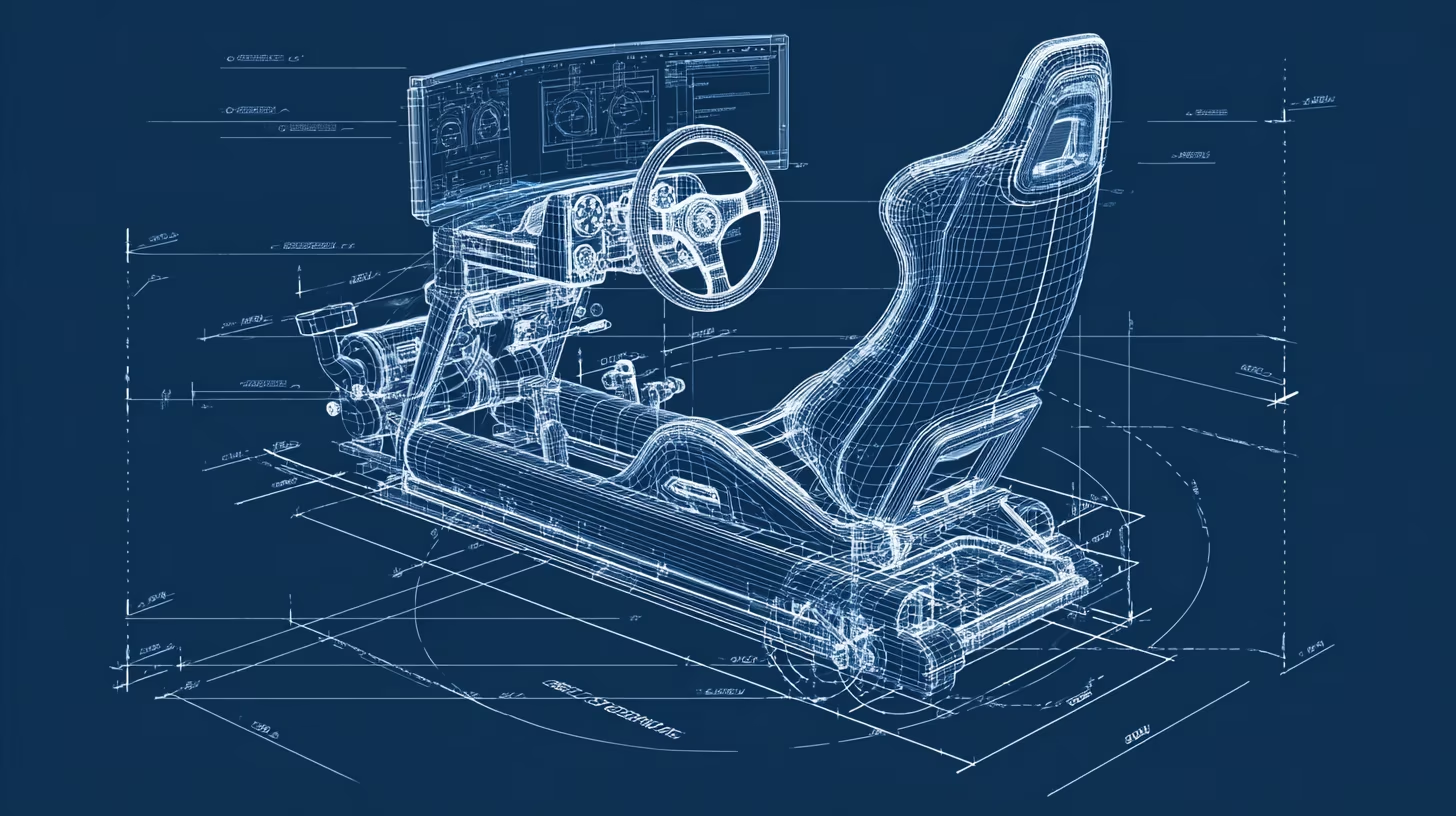
Max Verstappen does not only dominate real circuits, he also spends long hours in one of the most extreme home sim rigs ever built. Fans are not just curious about the gear, they want to know how it is laid out. How big is the rig? How far are the monitors? What is the seating angle? How do you build this at home? This guide uses public Verstappen rig documentation to turn his research-backed setup into a practical layout with measurements and a parts list.
Hub: See every driver rig in one place: Complete F1 Driver Sim Racing Setups (2025).
Verstappen’s home rig at a glance
- Formula style carbon cockpit (Playseat F1 Ultimate or Playseat Formula Intelligence)
- Direct drive wheelbase with very high torque (Leo Bodnar SimSteering2 Pro)
- Pro level pedals (Heusinkveld Sim Pedals Ultimate)
- Triple 32 inch curved monitors (Samsung Odyssey Neo G7) wrapped around the driver
- Raised pedal deck to mimic an actual F1 car
- Low mounted wheel just above the knees
- Fully reclined seating position
- Fourth screen for telemetry and tools
- High end PC to run triple 1440p at high FPS
This is not a gaming rig, it is a training tool.
Verstappen simulator layout (F1 style seating with measurements)
Cockpit geometry
| Component | Measurement or angle | Notes |
|---|---|---|
| Seat recline angle | 27-32 degrees from horizontal | Typical F1 posture supported by the Playseat F1 style tub |
| Leg elevation | 15-20 cm above hip height | Use the Playseat pedal riser or a compatible booster plate |
| Pedal distance | 85-110 cm from seat base | Adjust to driver height, Max runs a relatively long stretch |
| Pedal plate tilt | 10-15 degrees upward | More pressure on heels, close to Red Bull F1 ergonomics |
| Wheel height | 20-23 cm above knees | Mount wheel low in the tub |
| Wheel distance | 55-65 cm from driver chest | Normal for formula seating |
Triple monitor layout (Samsung Odyssey G7 32 inch)
| Element | Value |
|---|---|
| Center monitor distance | 60-70 cm from eyes |
| Side monitor angle | 38-45 degrees inward |
| Monitor height | Eyes level with top third of the screen |
| Total width (triple) | 125-135 cm |
| Curvature | 1000R wrapped closely around the driver |
Rig footprint
| Part | Size |
|---|---|
| Cockpit length | 150-165 cm |
| Width including monitors | 140-150 cm |
| Height | 120-140 cm depending on monitor stand |
The footprint fits most rooms while keeping Verstappen level ergonomics intact.
Full hardware list (matching Verstappen’s rig)
Cockpit and seat
- Playseat F1 Ultimate or Playseat Formula Intelligence
- Formula style seat with reclined carbon tub.
- Verstappen uses a custom elevated pedal mount, you can copy this with a booster plate or a rig compatible pedal riser.
Wheelbase
- Leo Bodnar SimSteering2 Pro at roughly 54 Nm torque.
- Alternative if you want to control budget: Simucube 2 Pro, the one he uses with Team Redline.
Steering wheels
- Precision Sim Engineering LM-X (formula style)
- Optional: Fanatec CSL GT3 as a close McLaren style option
Pedals
- Heusinkveld Sim Pedals Ultimate or Ultimate Plus
- Hydraulic dampers and load cells, set brake pressure heavy to mimic Verstappen style.
Shifter and handbrake
- Heusinkveld Sequential (Mag-Shift)
- Moza HBP Handbrake as closest available handbrake
Displays
- Three Samsung Odyssey Neo G7 32 inch curved monitors
- Fourth screen for telemetry, standings, CrewChief, force feedback tuning and tools
Audio
PC specs (for triple 1440p)
- RTX 3080, 4080 or 4090
- Ryzen 9 or Intel i9
- 32-64 GB RAM
- Fast NVMe SSD
Step by step build plan
Step 1, set up the cockpit
Place the Playseat F1 style cockpit centered in the room. Target 150-165 cm total length. Install the raised pedal mount so your legs sit higher than your hips.
Step 2, position the wheelbase
Mount the direct drive motor low, just above the knees. Keep wheel distance at 55-65 cm from your chest.
Step 3, install and angle the triple monitors
Keep the center monitor 65 cm from your eyes. Rotate side monitors 40-45 degrees inward. Tilt the top slightly downward by 2-5 degrees. Align the horizon line at eye level.
Step 4, configure the pedals
Set brake very stiff with a heavy load cell curve. Keep throttle smooth with moderate resistance. Tilt the pedal plate upward by about 10-15 degrees.
Step 5, add the fourth screen
Mount it above or to the right for telemetry tools like MoTeC or VRS, race data, iRacing black boxes and CrewChief overlays.
Step 6, cable routing
Use spine channels along the Playseat and Velcro ties to keep the rig tidy.
Step 7, software setup
iRacing for main racing, rFactor 2 for Le Mans Virtual physics, Assetto Corsa or ACC for GT work, CrewChief for radio, telemetry tools such as MoTeC, VRS, JRT or Racelab for analysis.
Verstappen inspired build tiers
Not everyone needs a EUR 20,000 setup. Pick a tier that fits budget and space.
Tier 1, Verstappen Lite (EUR 2,000-3,500)
Playseat Formula Pro, Moza R12 or Fanatec DD1, Heusinkveld Sprints, triple 27 inch monitors.
Tier 2, Verstappen Pro (EUR 6,000-10,000)
Playseat F1 Ultimate, Simucube 2 Pro, Heusinkveld Ultimates, triple 32 inch Samsung Odyssey Neo G7 monitors, telemetry workflow.
Tier 3, Verstappen Exact (EUR 15,000 and up)
Leo Bodnar SimSteering2 Pro, Precision Sim Engineering LM-X, Heusinkveld Sequential plus Handbrake, triple 32 inch Samsung Odyssey Neo G7, F1 posture build, high end PC with RTX 4090 class GPU.
Verstappen tuning tips
- No VR and no motion, he prefers stability and consistency.
- High wheel torque, he runs strong force feedback.
- Very stiff brake, near real F1 pedal pressure.
- Telemetry first, he reviews sector by sector data after races.
- Minimal haptics, relies on wheel detail and audio rather than seat shakers.
- Triple monitors for awareness, VR narrows focus too much for his taste.